
Basics
Amazon Listing Optimization for Amazon UAE and KSA: Tips and Tricks to Improve Visibility and Sales
Amazon Listing Optimization for Amazon UAE and KSA: Tips and Tricks to Improve Visibility and Sales
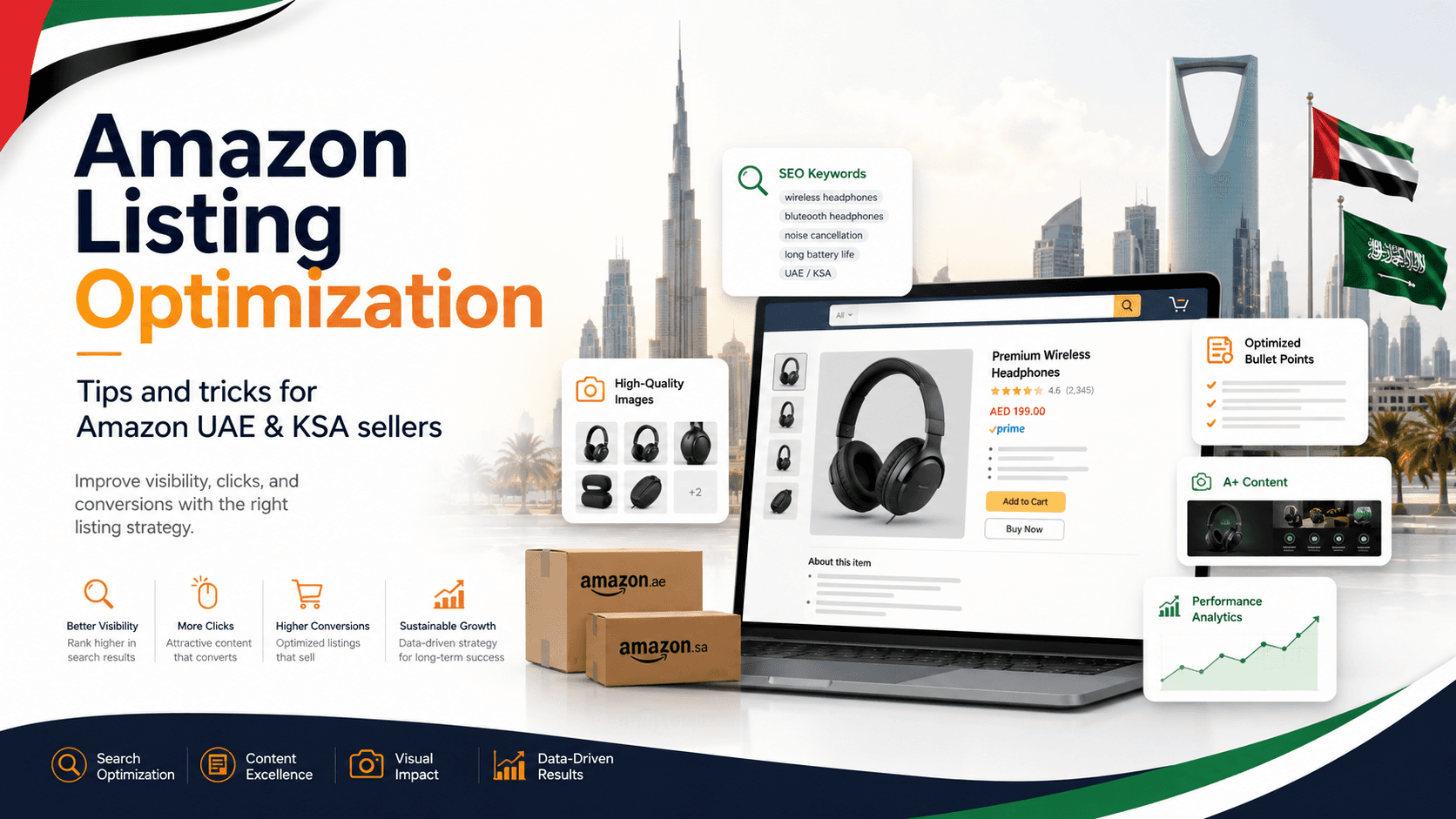
Selling on Amazon UAE and Amazon KSA is a major opportunity for brands that want to reach ready-to-buy customers across the region. But launching a product on Amazon is not enough. If your listing is not optimized, your product may struggle to appear in search results, attract clicks, or convert shoppers into buyers.
Amazon listing optimization is the process of improving every part of your product detail page — from the title and images to the bullet points, description, keywords, and A+ Content — so that your product is easier to find and more convincing to buy.
For sellers in the UAE and Saudi Arabia, this is even more important because customer behavior is evolving quickly. Shoppers compare products fast, browse heavily on mobile, and expect clear information before making a purchase decision. A strong listing helps your product stand out in search results, communicate value quickly, and build trust with the customer.
Amazon’s own product detail page rules emphasize that listings should accurately describe the product, follow category style guides, avoid misleading content, and give customers a clear shopping experience.
Need help in getting your products listed or your listings optimized on Amazon?
Why Amazon Listing Optimization Matters
A good Amazon listing does two important jobs.
First, it helps Amazon understand what your product is. This is where keywords, category selection, product attributes, and backend search terms matter.
Second, it helps customers understand why they should buy from you. This is where your images, title, bullet points, description, reviews, and A+ Content matter.
Many sellers focus only on traffic, but traffic is not always the problem. Sometimes the listing is getting impressions, but customers are not clicking. Sometimes they click, but they do not buy. That is why listing optimization should be treated as a conversion strategy, not just an SEO task.
1. Start With Keyword Research
Before writing your listing, you need to understand what customers are actually searching for on Amazon UAE and KSA.
Do not only rely on how you describe your product internally. Customers may search using simpler, broader, or more specific terms. For example, a brand may call its product a “hydrating facial mist,” but customers may search for “face spray,” “setting spray,” “skin mist,” or even Arabic variations depending on the market.
For Amazon UAE and KSA, your keyword research should include:
English search terms
Arabic search terms where relevant
Category-specific keywords
Use-case keywords
Competitor keywords
Problem-solution keywords
The goal is not to stuff your listing with keywords. The goal is to place the most important keywords naturally in the title, bullet points, description, and backend search terms.
2. Write a Strong Product Title
Your title is one of the most important parts of your Amazon listing. It affects both search visibility and click-through rate.
A strong title should clearly tell the customer what the product is, who it is for, and what makes it relevant. It should include your main keyword, but it should still sound natural and easy to read.
A good title structure can include:
Brand + Product Type + Key Feature + Size/Quantity + Main Use Case + Target Customer
For example:
Brand Name Hydrating Face Mist, 150ml, Refreshing Skin Spray for Daily Use, Suitable for Dry & Sensitive Skin
For Amazon UAE and KSA, avoid titles that are too vague. Customers should immediately understand what the product is without needing to open the listing.
3. Make Your Main Image Work Harder
Your main image is one of the biggest factors affecting clicks.
On Amazon, customers often make their first decision from the search results page. If your main image is unclear, too small, poorly lit, or does not show the product properly, your listing may lose clicks even if your product is strong.
Your main image should:
Show the product clearly
Use a clean white background
Fill the available image space
Make the packaging and product type easy to understand
Look professional and trustworthy
For UAE and KSA customers, packaging clarity matters. If your product has size, flavor, scent, quantity, or key usage information on the packaging, make sure it is visible and easy to read.
4. Use Secondary Images to Answer Buyer Questions
Your secondary images should not just show the product from different angles. They should help sell the product.
Think of your image stack as a mini sales page. Each image should answer a customer question or remove a buying objection.
Useful secondary image ideas include:
Key benefits image
Size or dimensions image
How-to-use image
Lifestyle image
Ingredients or material image
Before-and-after image, where allowed
Comparison image
What’s-in-the-box image
Arabic benefit image for local relevance
For Amazon UAE and KSA, bilingual visual content can be very powerful, especially for categories like beauty, grocery, baby, health, home, and personal care. The customer should be able to understand the product quickly, even while scrolling on mobile.
5. Write Bullet Points That Sell, Not Just Describe
Your bullet points should explain why the product matters.
A common mistake sellers make is listing features only. But customers care about what those features mean for them.
Instead of saying:
“Made with stainless steel.”
Say:
“DURABLE STAINLESS STEEL: Designed for long-lasting daily use, with a strong, rust-resistant finish that is easy to clean.”
Each bullet should focus on one clear selling point. Start with a strong uppercase heading, then explain the benefit in a natural sentence.
Strong bullet topics include:
Main product benefit
Material or quality
Usage occasion
Size or compatibility
Trust, safety, or convenience
Amazon’s product detail page guidance also highlights that content should be accurate and should not include prohibited elements such as external links, contact information, promotional claims, or requests for reviews.
6. Build Trust Through the Product Description
Your product description gives you more space to explain the product in a natural, persuasive way.
This section should not repeat the bullet points word for word. Instead, use it to tell the customer what the product is, why it is useful, and how it fits into their lifestyle.
For Amazon UAE and KSA, a strong product description can include:
A short introduction to the product
The main benefits and use cases
Who the product is suitable for
Important product details
A final line that reinforces confidence
Keep the language clear, professional, and customer-focused. Avoid exaggerated claims, medical claims, or anything that could create compliance issues.
7. Add A+ Content When Eligible
If your brand is eligible, A+ Content is one of the most valuable listing assets you can use.
A+ Content allows brand owners and authorized resellers to enhance product detail pages with richer visual content, product storytelling, comparison charts, and feature explanations. Amazon describes it as a way to showcase product features, communicate brand value, and help customers make more informed purchase decisions.
For Amazon UAE and KSA, A+ Content can help you:
Explain premium positioning
Educate customers about product benefits
Show product use cases visually
Reduce confusion
Build brand trust
Cross-compare variations or product ranges
A+ Content is especially important in categories where customers need more education before buying, such as beauty, supplements, baby products, electronics, home appliances, grocery, and wellness.
8. Do Not Ignore Backend Search Terms
Backend search terms help Amazon understand additional keywords related to your product.
This section is not visible to customers, but it can still support discoverability. Use it for relevant keywords that did not naturally fit into your title or bullet points.
For UAE and KSA listings, backend keywords may include:
Alternate spellings
Arabic keywords
English-Arabic mixed search terms
Use-case terms
Category synonyms
Customer search variations
Avoid repeating the same keywords already used heavily in your listing. Also avoid competitor brand names, misleading terms, or irrelevant keywords.
9. Localize for UAE and Saudi Customers
Amazon UAE and Amazon KSA are not identical markets. Customer expectations, language preferences, pricing sensitivity, category demand, and cultural context can differ.
For KSA, Arabic content can be especially important depending on the product category. For UAE, English is widely used, but Arabic can still improve clarity and customer connection.
Localization can include:
Arabic keywords
Arabic image text where relevant
Region-specific use cases
Local lifestyle examples
Correct sizing, measurements, and compatibility
Clear delivery and fulfillment expectations
The more your listing feels relevant to the local shopper, the stronger your chance of conversion.
10. Optimize for Mobile First
Many Amazon shoppers browse and buy from their phones. That means your content needs to be easy to understand on a small screen.
Mobile-first listing optimization means:
Your title should be clear from the first few words
Your main image should be instantly recognizable
Your secondary images should use large, readable text
Your bullet points should be concise
Your A+ Content should not rely on tiny details
Before finalizing your listing, check how it looks on mobile. If the customer needs to zoom in to understand the product, the content needs improvement.
11. Use Data to Keep Improving
Listing optimization is not a one-time task.
After your product is live, monitor your performance. Look at impressions, click-through rate, conversion rate, sessions, sales, and advertising performance.
If your impressions are low, you may have a keyword or category issue.
If your clicks are low, your title, main image, price, or reviews may need work.
If your sessions are strong but sales are low, your images, bullet points, pricing, offer, or reviews may be affecting conversion.
For eligible brand owners, Amazon’s Manage Your Experiments tool allows sellers to A/B test listing content and compare what performs better, helping reduce guesswork in optimization.
Selling on Amazon UAE and Amazon KSA is a major opportunity for brands that want to reach ready-to-buy customers across the region. But launching a product on Amazon is not enough. If your listing is not optimized, your product may struggle to appear in search results, attract clicks, or convert shoppers into buyers.
Amazon listing optimization is the process of improving every part of your product detail page — from the title and images to the bullet points, description, keywords, and A+ Content — so that your product is easier to find and more convincing to buy.
For sellers in the UAE and Saudi Arabia, this is even more important because customer behavior is evolving quickly. Shoppers compare products fast, browse heavily on mobile, and expect clear information before making a purchase decision. A strong listing helps your product stand out in search results, communicate value quickly, and build trust with the customer.
Amazon’s own product detail page rules emphasize that listings should accurately describe the product, follow category style guides, avoid misleading content, and give customers a clear shopping experience.
Need help in getting your products listed or your listings optimized on Amazon?
Why Amazon Listing Optimization Matters
A good Amazon listing does two important jobs.
First, it helps Amazon understand what your product is. This is where keywords, category selection, product attributes, and backend search terms matter.
Second, it helps customers understand why they should buy from you. This is where your images, title, bullet points, description, reviews, and A+ Content matter.
Many sellers focus only on traffic, but traffic is not always the problem. Sometimes the listing is getting impressions, but customers are not clicking. Sometimes they click, but they do not buy. That is why listing optimization should be treated as a conversion strategy, not just an SEO task.
1. Start With Keyword Research
Before writing your listing, you need to understand what customers are actually searching for on Amazon UAE and KSA.
Do not only rely on how you describe your product internally. Customers may search using simpler, broader, or more specific terms. For example, a brand may call its product a “hydrating facial mist,” but customers may search for “face spray,” “setting spray,” “skin mist,” or even Arabic variations depending on the market.
For Amazon UAE and KSA, your keyword research should include:
English search terms
Arabic search terms where relevant
Category-specific keywords
Use-case keywords
Competitor keywords
Problem-solution keywords
The goal is not to stuff your listing with keywords. The goal is to place the most important keywords naturally in the title, bullet points, description, and backend search terms.
2. Write a Strong Product Title
Your title is one of the most important parts of your Amazon listing. It affects both search visibility and click-through rate.
A strong title should clearly tell the customer what the product is, who it is for, and what makes it relevant. It should include your main keyword, but it should still sound natural and easy to read.
A good title structure can include:
Brand + Product Type + Key Feature + Size/Quantity + Main Use Case + Target Customer
For example:
Brand Name Hydrating Face Mist, 150ml, Refreshing Skin Spray for Daily Use, Suitable for Dry & Sensitive Skin
For Amazon UAE and KSA, avoid titles that are too vague. Customers should immediately understand what the product is without needing to open the listing.
3. Make Your Main Image Work Harder
Your main image is one of the biggest factors affecting clicks.
On Amazon, customers often make their first decision from the search results page. If your main image is unclear, too small, poorly lit, or does not show the product properly, your listing may lose clicks even if your product is strong.
Your main image should:
Show the product clearly
Use a clean white background
Fill the available image space
Make the packaging and product type easy to understand
Look professional and trustworthy
For UAE and KSA customers, packaging clarity matters. If your product has size, flavor, scent, quantity, or key usage information on the packaging, make sure it is visible and easy to read.
4. Use Secondary Images to Answer Buyer Questions
Your secondary images should not just show the product from different angles. They should help sell the product.
Think of your image stack as a mini sales page. Each image should answer a customer question or remove a buying objection.
Useful secondary image ideas include:
Key benefits image
Size or dimensions image
How-to-use image
Lifestyle image
Ingredients or material image
Before-and-after image, where allowed
Comparison image
What’s-in-the-box image
Arabic benefit image for local relevance
For Amazon UAE and KSA, bilingual visual content can be very powerful, especially for categories like beauty, grocery, baby, health, home, and personal care. The customer should be able to understand the product quickly, even while scrolling on mobile.
5. Write Bullet Points That Sell, Not Just Describe
Your bullet points should explain why the product matters.
A common mistake sellers make is listing features only. But customers care about what those features mean for them.
Instead of saying:
“Made with stainless steel.”
Say:
“DURABLE STAINLESS STEEL: Designed for long-lasting daily use, with a strong, rust-resistant finish that is easy to clean.”
Each bullet should focus on one clear selling point. Start with a strong uppercase heading, then explain the benefit in a natural sentence.
Strong bullet topics include:
Main product benefit
Material or quality
Usage occasion
Size or compatibility
Trust, safety, or convenience
Amazon’s product detail page guidance also highlights that content should be accurate and should not include prohibited elements such as external links, contact information, promotional claims, or requests for reviews.
6. Build Trust Through the Product Description
Your product description gives you more space to explain the product in a natural, persuasive way.
This section should not repeat the bullet points word for word. Instead, use it to tell the customer what the product is, why it is useful, and how it fits into their lifestyle.
For Amazon UAE and KSA, a strong product description can include:
A short introduction to the product
The main benefits and use cases
Who the product is suitable for
Important product details
A final line that reinforces confidence
Keep the language clear, professional, and customer-focused. Avoid exaggerated claims, medical claims, or anything that could create compliance issues.
7. Add A+ Content When Eligible
If your brand is eligible, A+ Content is one of the most valuable listing assets you can use.
A+ Content allows brand owners and authorized resellers to enhance product detail pages with richer visual content, product storytelling, comparison charts, and feature explanations. Amazon describes it as a way to showcase product features, communicate brand value, and help customers make more informed purchase decisions.
For Amazon UAE and KSA, A+ Content can help you:
Explain premium positioning
Educate customers about product benefits
Show product use cases visually
Reduce confusion
Build brand trust
Cross-compare variations or product ranges
A+ Content is especially important in categories where customers need more education before buying, such as beauty, supplements, baby products, electronics, home appliances, grocery, and wellness.
8. Do Not Ignore Backend Search Terms
Backend search terms help Amazon understand additional keywords related to your product.
This section is not visible to customers, but it can still support discoverability. Use it for relevant keywords that did not naturally fit into your title or bullet points.
For UAE and KSA listings, backend keywords may include:
Alternate spellings
Arabic keywords
English-Arabic mixed search terms
Use-case terms
Category synonyms
Customer search variations
Avoid repeating the same keywords already used heavily in your listing. Also avoid competitor brand names, misleading terms, or irrelevant keywords.
9. Localize for UAE and Saudi Customers
Amazon UAE and Amazon KSA are not identical markets. Customer expectations, language preferences, pricing sensitivity, category demand, and cultural context can differ.
For KSA, Arabic content can be especially important depending on the product category. For UAE, English is widely used, but Arabic can still improve clarity and customer connection.
Localization can include:
Arabic keywords
Arabic image text where relevant
Region-specific use cases
Local lifestyle examples
Correct sizing, measurements, and compatibility
Clear delivery and fulfillment expectations
The more your listing feels relevant to the local shopper, the stronger your chance of conversion.
10. Optimize for Mobile First
Many Amazon shoppers browse and buy from their phones. That means your content needs to be easy to understand on a small screen.
Mobile-first listing optimization means:
Your title should be clear from the first few words
Your main image should be instantly recognizable
Your secondary images should use large, readable text
Your bullet points should be concise
Your A+ Content should not rely on tiny details
Before finalizing your listing, check how it looks on mobile. If the customer needs to zoom in to understand the product, the content needs improvement.
11. Use Data to Keep Improving
Listing optimization is not a one-time task.
After your product is live, monitor your performance. Look at impressions, click-through rate, conversion rate, sessions, sales, and advertising performance.
If your impressions are low, you may have a keyword or category issue.
If your clicks are low, your title, main image, price, or reviews may need work.
If your sessions are strong but sales are low, your images, bullet points, pricing, offer, or reviews may be affecting conversion.
For eligible brand owners, Amazon’s Manage Your Experiments tool allows sellers to A/B test listing content and compare what performs better, helping reduce guesswork in optimization.
Ready to grow your Amazon
business with Expert Guidance?
Join 1000+ growing network of Amazon entrepreneurs
building real, profitable brands.
THINK
BIG!
SELL
BIGGER!!
Amazon
Sellers Society
Seller Society is our official registered company name. 'Amazon Sellers Society' is our online persona and YouTube channel. Amazon is a trademark of Amazon.com, Inc. We are an independent Amazon Service Provider Network member and are not affiliated with or endorsed by Amazon.




amazonsellerssociety©️2026
All Rights Reserved
Ready to grow your Amazon business with Expert Guidance?
Join 1000+ growing network of Amazon entrepreneurs building real, profitable brands.
THINK
BIG!
SELL
BIGGER!!
Amazon
Sellers Society
Seller Society is our official registered company name. 'Amazon Sellers Society' is our online persona and YouTube channel. Amazon is a trademark of Amazon.com, Inc. We are an independent Amazon Service Provider Network member and are not affiliated with or endorsed by Amazon.
amazonsellerssociety©️2026
All Rights Reserved
Ready to grow your Amazon
business with Expert Guidance?
Join 1000+ growing network of Amazon entrepreneurs
building real, profitable brands.
THINK
BIG!
SELL
BIGGER!!
Amazon
Sellers Society
Seller Society is our official registered company name. 'Amazon Sellers Society' is our online persona and YouTube channel. Amazon is a trademark of Amazon.com, Inc. We are an independent Amazon Service Provider Network member and are not affiliated with or endorsed by Amazon.
amazonsellerssociety©️2026
All Rights Reserved