
Basics
Amazon Listing Checklist for UAE & KSA Sellers: Optimize Like a Pro
Amazon Listing Checklist for UAE & KSA Sellers: Optimize Like a Pro
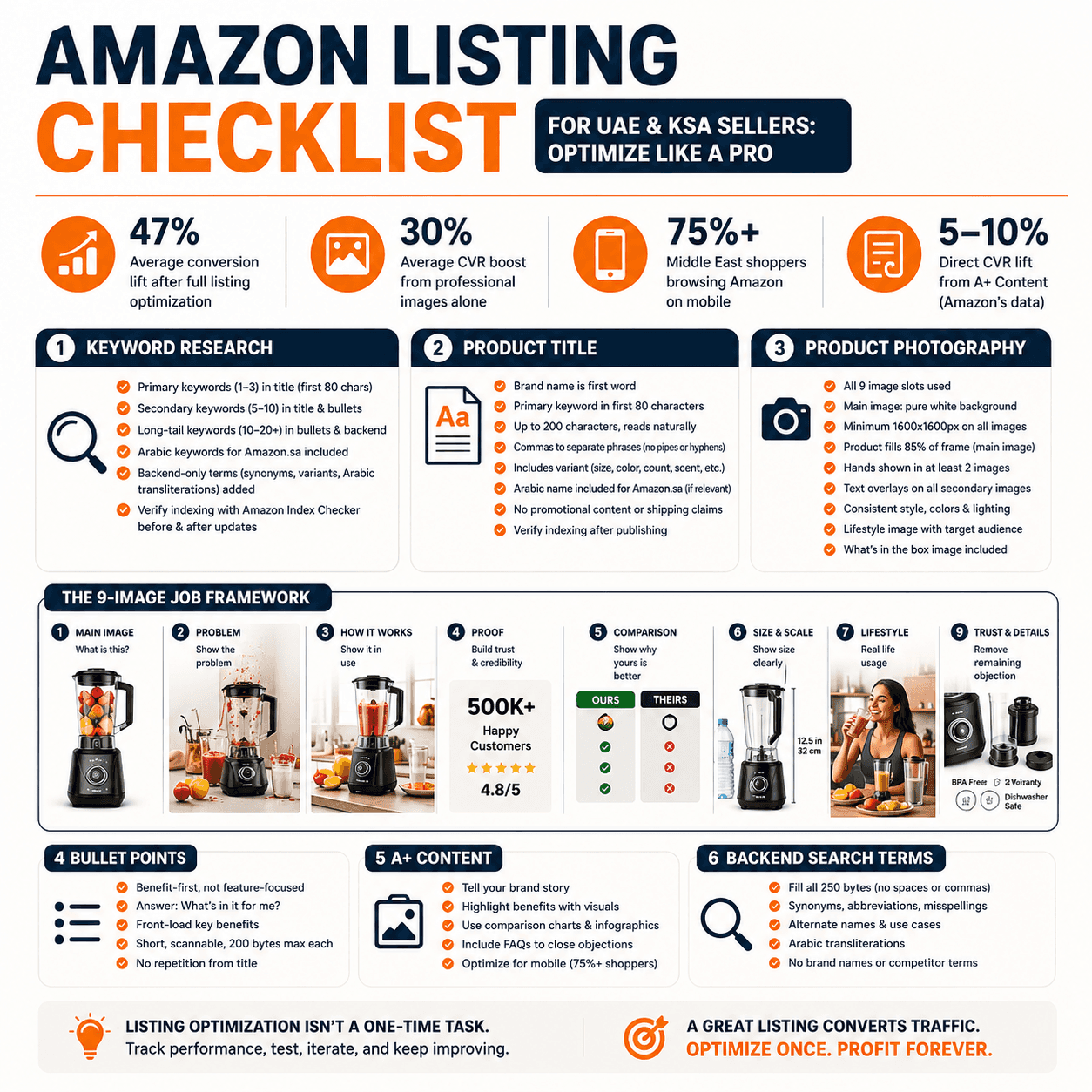
Amazon Listing Checklist for UAE & KSA Sellers: Optimize Like a Pro
Sellers Society | Amazon & Marketplace Seller Agency
Your listing is where every ad dirham either converts or gets wasted. Most Amazon sellers on Amazon.ae and Amazon.sa spend heavily on PPC while sending traffic to listings with weak images, keyword-stuffed titles, feature-heavy bullets, and A+ content that looks like a product manual. This checklist covers every element of your listing — adapted for the Middle East market. Work through it once and your listing will outperform the majority of what's live on Amazon.ae and Amazon.sa right now.
Stat | What It Means |
|---|---|
47% | Average conversion lift after full listing optimization |
30% | Average CVR boost from professional images alone |
75%+ | Middle East shoppers browsing Amazon on mobile |
5–10% | Direct CVR lift from A+ Content (Amazon's own data) |
Step 1: Keyword Research — The Foundation of Everything
You cannot write a good title, useful bullets, or effective A+ content without first knowing what your buyers are actually searching for. On Amazon.ae and Amazon.sa, this means researching in both English and Arabic — and understanding that search behavior in the Gulf differs from Amazon.com.
Primary Keywords (1–3) Place in the title within the first 80 characters. Find them by running a reverse-ASIN on your top 3 competitors in Helium 10 Cerebro. Highest volume, most relevant terms only.
Secondary Keywords (5–10) Place in the title (remaining space) and bullets. Use Jungle Scout Keyword Scout. Terms with solid volume that didn't fit in primary placement.
Long-tail Keywords (10–20+) Place in bullets, A+ alt text, and backend. Use Amazon autocomplete, competitor title mining, and customer Q&A language. Lower volume but high purchase intent.
Arabic Keywords For Amazon.sa specifically, Arabic search terms are critical. Middle East shoppers — particularly in KSA — often search in Arabic. Include your primary product terms in Arabic script in both your visible copy and backend fields. This is one of the most consistently overlooked opportunities on Amazon.sa.
Backend-Only Terms Synonyms, common misspellings, alternate product names, and Arabic transliterations that wouldn't appear in visible copy.
✅ Verify indexing using the Amazon Index Checker or LQS Chrome extension. A keyword in your title that Amazon isn't indexing is invisible to the algorithm. Check before and after every listing update.
Step 2: Product Title — Your #1 Ranking Factor
Your title carries more ranking weight than any other listing element. On mobile — where 75%+ of Middle East shoppers browse — only the first 80 characters are visible before truncation. If your key benefit is buried in character 120, the majority of your buyers never see it.
Title Checklist:
[ ] Brand name is the first word
[ ] Primary keyword appears within the first 80 characters
[ ] Title uses up to 200 characters (use the full space with meaningful content, not filler)
[ ] Reads naturally — keyword stuffing hurts readability and Amazon's AI penalizes unnatural language
[ ] Uses commas to separate keyword phrases — not pipes or hyphens
[ ] First letter of every word is capitalized. No ALL CAPS words except acronyms
[ ] Numbers written as numerals ("3 pack" not "three pack")
[ ] Words spelled out, not abbreviated ("inches" not "in")
[ ] Includes product variant where applicable (size, color, count, scent)
[ ] For Amazon.sa: consider including the Arabic product name naturally if it fits
[ ] No promotional content — no "best seller," price mentions, or shipping claims in title
[ ] Verified with Amazon Index Checker after publishing
Step 3: Product Photography — Your #1 Conversion Driver
Images are the most important conversion driver on your listing. Middle East shoppers on mobile swipe through your image stack before reading a single word of copy. Your images must communicate your product's value proposition completely on their own — because a significant portion of your buyers will never scroll down to the bullets.
The 9-Image Job Framework
Every image should do one specific job. If an image tries to do more than one thing, it usually does none of them well.
Slot | Job |
|---|---|
1 — Main Image | Pure white background. Product fills 85% of frame. Answers "what is this?" in 3 seconds. |
2 — Problem | Visually show the problem this product solves. Make the pain real before showing the solution. |
3 — How It Works | Product in use without instructions. Viewer understands function in one glance. |
4 — Proof | Social proof grid, results, testimonial image, certifications, or "500K+ customers" claim. |
5 — Comparison | Side-by-side vs competitor. Show why yours wins on the 2–3 factors that matter most. |
6 — Size & Scale | Hands holding the product. Everyday object for reference. Dimensions labeled clearly. |
7 — Lifestyle | Product in real use by your target demographic. Emotional context. Believable, not staged. |
8 — What's in Box | Everything included laid out clearly. Reduces return rate and "not as described" complaints. |
9 — Trust & Details | Warranty, certifications, close-up detail shots, materials. Remove any remaining objection. |
Photography Checklist:
[ ] All 9 image slots used — empty slots are wasted conversion opportunities
[ ] Main image: pure white background (RGB 255,255,255) — Amazon can auto-replace non-compliant main images
[ ] Minimum 1600×1600px on all images — activates Amazon's zoom function
[ ] Product fills 85% of frame in main image
[ ] Hands included in at least 2 images — gives buyers an instinctive feel for real-world scale
[ ] Text overlays on all secondary images — label every benefit you're highlighting
[ ] Text uses large fonts, max 30% of image area — must be readable on mobile
[ ] Size chart included if applicable — reduces returns on apparel, accessories, and wearables
[ ] Real lifestyle photography, not stock — Middle East shoppers can detect staged imagery, and it reduces trust
[ ] Model matches your target demographic
[ ] Social proof grid image created — 2×3 or 3×3 grid of real customers using the product
[ ] No watermarks or promotional text on main image
[ ] Middle East-specific: lifestyle images should reflect the regional context where relevant — local settings, modest imagery requirements for KSA listings, and Arabic text overlays on secondary images resonate strongly with Gulf buyers
Step 4: Product Offer — Price Anchoring and Coupon Strategy
Your price and promotional structure directly impact both your CTR in search results and your on-page conversion rate. This is one of the most overlooked optimization levers.
Offer Checklist:
[ ] MSRP strikethrough price always shown alongside sale price — creates deal perception and purchase urgency
[ ] Sale price is competitive for your category — check your top 3 competitors weekly. Being 20%+ above average requires visible differentiation in listing quality
[ ] Use a Coupon over a Promotion — coupons show as a green "Save AED X" badge in search results, improving CTR. Promotions are invisible in search
[ ] Coupon uses a Dirham amount, not a percentage — "Save AED 15" converts better than "Save 8%" because shoppers can immediately grasp the value
[ ] Coupon budget set realistically — account for Amazon's redemption fee per coupon use
[ ] Max order quantity set when running promotions — prevents bulk buyers from draining inventory at a loss
[ ] Launch pricing is competitive or below market — during the first 30–60 days, price to generate velocity and reviews before raising to your target price
Step 5: Bullet Points — Where Keywords Meet Conversion Copy
Most sellers write bullets that list features. Top sellers write bullets that answer the buyer's single question: does this solve my problem better than the alternatives I'm looking at?
The Structure That Converts:
❌ Feature-first (doesn't convert): Double-walled stainless steel construction with vacuum insulation. BPA-free. Available in multiple sizes.
✅ Benefit-first (converts): KEEPS DRINKS COLD FOR 24 HOURS — Double-walled vacuum insulation maintains ice-cold temperatures through your entire day — from morning commute to evening workout. BPA-free and tested to international safety standards. Your ice will still be there at dinner.
Bullet Checklist:
[ ] All 5 bullet points written at 250+ characters each
[ ] CAPS benefit header at the start of each bullet — lets skim-readers get the key message without reading full sentences
[ ] Benefit stated before feature in every bullet
[ ] Bullet 1: Primary benefit — the #1 reason someone buys this product
[ ] Bullet 2: Key differentiator — what makes yours better than the competitor
[ ] Bullet 3: Use case scenario — help the shopper visualize using it in their daily life
[ ] Bullet 4: Addresses the #1 fear or objection about your product category (check your 1 and 2-star reviews for the most common concerns)
[ ] Bullet 5: Trust builder — warranty, review count, money-back guarantee, certifications
[ ] Secondary keywords woven naturally throughout — never force keywords in a way that breaks readability
[ ] For Amazon.sa: key bullet content available in Arabic — at minimum, the primary benefit headline
[ ] Language pulled from real customer reviews and Q&A — write in your buyer's words, not your brand's words
Step 6: A+ Content — The Conversion Multiplier
Amazon reports a 5–10% direct CVR lift from A+ Content. It's one of the most underinvested elements in Gulf seller listings, and one of the highest-return improvements available to Brand Registered sellers.
Does A+ Content help SEO? Yes — Amazon indexes keywords in your A+ content, including alt text on A+ images. It also directly influences Amazon's AI shopping recommendations, which read A+ modules as part of their full-listing analysis.
A+ Content Checklist:
[ ] Minimum 1,750 characters of copy across A+ modules
[ ] Comparison module included — one of the highest-converting A+ module types
[ ] Brand story module — where you started, why this product exists. Humanizes the brand in a way no other listing element can
[ ] Lifestyle imagery in every image module — not product-on-white again; A+ is where you tell the visual story
[ ] Keywords in all image alt text fields — this is indexed by Amazon
[ ] Social proof grid image included — 2×3 or 3×3 grid of real customers using the product
[ ] Sizing chart included if applicable
[ ] Answers the top 3–5 customer Q&A questions visually — check your Q&A section and competitors' for what's asked most
[ ] Cross-sells other products from your line — increases average order value across your catalog
[ ] Mobile responsive layout — test on your phone before publishing; many A+ layouts that look good on desktop are unreadable on mobile
[ ] Middle East-specific: include Arabic content modules for KSA listings. An A+ brand story told in Arabic — even partially — builds significantly more trust with Saudi shoppers than English-only content
[ ] Premium A+ enabled if eligible — interactive modules drive measurably higher conversion rates
Step 7: Backend Keywords — Hidden Ranking Power
Backend search terms are invisible to shoppers but fully indexed by Amazon's algorithm. Most sellers leave them empty or fill them with duplicates from their title. Both approaches waste valuable ranking real estate.
Backend Checklist:
[ ] No keywords duplicated from title or bullets — Amazon doesn't reward repetition; use this space for terms that couldn't fit elsewhere
[ ] No commas between terms — separate with spaces only
[ ] Synonyms and alternate product names included — what else do buyers call your product?
[ ] Common misspellings included — buyers search with typos, and competitors miss these searches
[ ] Arabic terms for Amazon.ae and Amazon.sa — include Arabic transliterations and Arabic keywords for your product category. Middle East shoppers who search in Arabic and find your listing through backend indexing are high-intent buyers
[ ] Subject Matter field used — add up to 5 additional keywords in the Subject Matter attribute field for bonus indexing
[ ] Full 249 bytes used — calculate your byte count to maximize every available character of indexing opportunity
[ ] Verified with LQS Chrome extension after update
Step 8: Customer Q&A — The Conversion Tool Most Sellers Ignore
Every question a potential buyer asks is an objection standing between them and a purchase. Answering quickly, thoroughly, and with keywords woven in naturally converts undecided shoppers — and builds content that Amazon's AI reads to make product recommendations.
Q&A Checklist:
[ ] Check Q&A daily — every unanswered question is a conversion killer. Aim to respond within 24 hours
[ ] Always be the first to answer — other customers, or even competitors, can answer your questions incorrectly
[ ] Include keywords naturally in answers — Q&A answers are indexed by Amazon
[ ] Never give a one-word answer — "Yes" or "No" misses the indexing opportunity and feels dismissive
[ ] Mine competitor Q&A for proactive questions — seed those same questions on your listing and answer them before they get asked
[ ] Target 100+ Q&As as a long-term goal — high Q&A count functions as social proof for new buyers
[ ] Report irrelevant or harmful questions — don't answer them, report them for removal
[ ] Middle East-specific: answer questions in both English and Arabic where possible. A bilingual Q&A answer builds trust and captures Arabic search indexing simultaneously
[ ] Turn frequently asked questions into listing improvements — if the same question appears 5+ times, that information belongs in your bullets or A+ content
Step 9: Reviews — The Biggest Conversion Factor on Your Page
Reviews are the single biggest conversion factor on Amazon. A product with 4 reviews will lose to one with 200 reviews in the same category almost every time — regardless of which product is objectively better. In the Middle East market, this trust gap is even wider because Amazon.ae and Amazon.sa are relatively new platforms and buyer confidence in unfamiliar sellers is lower.
The Review Math:
Factor | Reality |
|---|---|
Amazon's organic review rate | 1–2% of orders |
Orders needed for 50 reviews organically | 2,500–5,000 |
Trust threshold where CVR stabilizes | 50+ reviews |
Minimum before scaling PPC | 25+ reviews |
You cannot wait for organic reviews. You need a proactive strategy.
Reviews Checklist:
[ ] Manual "Request a Review" button clicked for every order — 3–5x more effective than no request. Automate with Helium 10 Follow-Up
[ ] Insert cards in all FBA packaging — ask for honest feedback. No incentives; no asking only for positive reviews
[ ] Image and video reviews prioritized — specifically invite photo submissions in review requests. Image reviews convert at higher rates than text-only reviews
[ ] 8 five-star reviews visible in Top Reviews before "see more" — upvote your 4 and 5-star reviews using the "Helpful" button to push them above the fold
[ ] Overall rating maintained at 4.3+ — below this, conversion drops significantly regardless of review count
[ ] Feedback Manager monitored — incorrect or unfair reviews can be flagged within 90 days. Don't let removable negative reviews sit unchallenged
[ ] Product listing accurately represents the product — the most effective review strategy is preventing negative reviews through accurate images and descriptions
[ ] Middle East-specific: Arabic-language reviews carry significant weight with KSA shoppers. If you have satisfied Gulf customers, your review request messaging should encourage them to review in their preferred language
Bonus: Power Moves That Separate Page-One Sellers from Everyone Else
Get Brand Registered. Brand Registry unlocks A+ Content, Sponsored Brands ads, Brand Analytics, the Brand Storefront, and protection against listing hijackers. If you're selling a branded product on Amazon.ae or Amazon.sa without Brand Registry, this is your single most important action item.
Never run out of stock. Going out of stock immediately tanks your organic ranking. Recovery can take weeks and requires significant PPC spend to rebuild. Inventory management is an optimization strategy, not just a logistics task.
List in multiple relevant categories. Each additional relevant category gives you another opportunity for a Best Seller Badge, which appears in search results and functions as a powerful trust signal.
Mention your warranty everywhere. Warranty language in your bullets, images, A+ content, and Q&A consistently lifts conversion rate across categories. In the Middle East market — where buyer trust in new sellers is still building — this is especially effective. It removes the most common purchase hesitation: "what if it breaks?"
Leverage Amazon's return policy as a selling point. "Shop with confidence — Amazon's 30-day return policy applies to this product" in your bullet copy removes risk from the purchase decision without costing you anything.
The 90-Day Optimization Roadmap
Month 1 — Foundation Week 1: Deep keyword research in Helium 10 Cerebro on your top 5 competitors. Include Arabic keyword research for Amazon.sa. Build your keyword tier map. Week 2: Rewrite title using primary keywords in first 80 characters. Verify indexing. Week 3: Shoot or commission all 9 listing images using the job framework above. Week 4: Rewrite all 5 bullet points in benefit-first structure with CAPS headers. Populate backend keywords with synonyms, Arabic terms, and misspellings. Target: 15–25% CVR improvement within 30 days of image update.
Month 2 — Depth Weeks 5–6: Build and publish A+ Content with comparison module, brand story, social proof grid, full alt text keyword coverage, and Arabic content for KSA listings. Weeks 7–8: Seed 10–15 Q&A questions from competitor listings. Answer all existing Q&As with keyword-rich, bilingual responses within 24 hours. Target: A+ Content live, Q&A count growing, Arabic content in place.
Month 3 — Amplification Weeks 9–10: Implement insert card review requests, click Manual Request a Review on all existing orders, and activate any ManyChat customer list broadcasts. Target 50+ reviews. Weeks 11–12: With a conversion-optimized listing, now scale PPC intelligently. Every improvement in conversion rate directly lowers your effective cost per click and improves organic rank. Target: 50+ reviews, 4.3+ rating, conversion rate 40%+ above Day 1 baseline.
The Most Common Mistakes Gulf Sellers Make
Optimizing the title without doing keyword research first. The keywords you think your buyers are searching are rarely the keywords they're actually using — especially when Arabic search behavior is involved. Do the research first.
Leaving backend keywords empty or filled with title duplicates. This is free ranking power — including Arabic keyword indexing — that requires 15 minutes to fix and most sellers never touch.
Launching PPC before the listing is conversion-ready. Sending paid traffic to a listing with 3 reviews and a weak image stack on Amazon.ae or Amazon.sa is an expensive way to generate data on a listing that was never going to convert. Get to 25+ reviews and a full optimized image stack first.
Skipping Arabic content entirely. Sellers who treat Amazon.ae and Amazon.sa as English-only platforms leave a significant conversion advantage on the table. Arabic title, bullets, A+ content, and Q&A responses are trust signals — particularly on Amazon.sa — that English-only listings cannot replicate.
Treating optimization as a one-time launch task. The Middle East marketplace is growing and evolving fast. Competitors improve. New sellers enter categories. Seasonal search behavior shifts dramatically around Ramadan, Eid, and national holiday periods. Audit your top listings quarterly at minimum, and do a pre-season optimization pass before every major Gulf shopping period.
Ready to Optimize Your Amazon.ae or Amazon.sa Listing?
Most Middle East sellers have listings that were built for Amazon.com and never properly adapted for the regional market. The gap between a default listing and a properly optimized one — with Arabic content, Middle East-specific imagery, and the right keyword coverage — is one of the clearest competitive advantages still available on Amazon.ae and Amazon.sa.
Sellers Society works with Middle East-based sellers on Amazon.ae, Amazon.sa, and other marketplaces to audit, optimize, and produce content for every element of this checklist — so your PPC spend builds rank instead of burning margin.
Book A Free Call
Sellers Society | Amazon & Marketplace Seller Agency
Amazon Listing Checklist for UAE & KSA Sellers: Optimize Like a Pro
Sellers Society | Amazon & Marketplace Seller Agency
Your listing is where every ad dirham either converts or gets wasted. Most Amazon sellers on Amazon.ae and Amazon.sa spend heavily on PPC while sending traffic to listings with weak images, keyword-stuffed titles, feature-heavy bullets, and A+ content that looks like a product manual. This checklist covers every element of your listing — adapted for the Middle East market. Work through it once and your listing will outperform the majority of what's live on Amazon.ae and Amazon.sa right now.
Stat | What It Means |
|---|---|
47% | Average conversion lift after full listing optimization |
30% | Average CVR boost from professional images alone |
75%+ | Middle East shoppers browsing Amazon on mobile |
5–10% | Direct CVR lift from A+ Content (Amazon's own data) |
Step 1: Keyword Research — The Foundation of Everything
You cannot write a good title, useful bullets, or effective A+ content without first knowing what your buyers are actually searching for. On Amazon.ae and Amazon.sa, this means researching in both English and Arabic — and understanding that search behavior in the Gulf differs from Amazon.com.
Primary Keywords (1–3) Place in the title within the first 80 characters. Find them by running a reverse-ASIN on your top 3 competitors in Helium 10 Cerebro. Highest volume, most relevant terms only.
Secondary Keywords (5–10) Place in the title (remaining space) and bullets. Use Jungle Scout Keyword Scout. Terms with solid volume that didn't fit in primary placement.
Long-tail Keywords (10–20+) Place in bullets, A+ alt text, and backend. Use Amazon autocomplete, competitor title mining, and customer Q&A language. Lower volume but high purchase intent.
Arabic Keywords For Amazon.sa specifically, Arabic search terms are critical. Middle East shoppers — particularly in KSA — often search in Arabic. Include your primary product terms in Arabic script in both your visible copy and backend fields. This is one of the most consistently overlooked opportunities on Amazon.sa.
Backend-Only Terms Synonyms, common misspellings, alternate product names, and Arabic transliterations that wouldn't appear in visible copy.
✅ Verify indexing using the Amazon Index Checker or LQS Chrome extension. A keyword in your title that Amazon isn't indexing is invisible to the algorithm. Check before and after every listing update.
Step 2: Product Title — Your #1 Ranking Factor
Your title carries more ranking weight than any other listing element. On mobile — where 75%+ of Middle East shoppers browse — only the first 80 characters are visible before truncation. If your key benefit is buried in character 120, the majority of your buyers never see it.
Title Checklist:
[ ] Brand name is the first word
[ ] Primary keyword appears within the first 80 characters
[ ] Title uses up to 200 characters (use the full space with meaningful content, not filler)
[ ] Reads naturally — keyword stuffing hurts readability and Amazon's AI penalizes unnatural language
[ ] Uses commas to separate keyword phrases — not pipes or hyphens
[ ] First letter of every word is capitalized. No ALL CAPS words except acronyms
[ ] Numbers written as numerals ("3 pack" not "three pack")
[ ] Words spelled out, not abbreviated ("inches" not "in")
[ ] Includes product variant where applicable (size, color, count, scent)
[ ] For Amazon.sa: consider including the Arabic product name naturally if it fits
[ ] No promotional content — no "best seller," price mentions, or shipping claims in title
[ ] Verified with Amazon Index Checker after publishing
Step 3: Product Photography — Your #1 Conversion Driver
Images are the most important conversion driver on your listing. Middle East shoppers on mobile swipe through your image stack before reading a single word of copy. Your images must communicate your product's value proposition completely on their own — because a significant portion of your buyers will never scroll down to the bullets.
The 9-Image Job Framework
Every image should do one specific job. If an image tries to do more than one thing, it usually does none of them well.
Slot | Job |
|---|---|
1 — Main Image | Pure white background. Product fills 85% of frame. Answers "what is this?" in 3 seconds. |
2 — Problem | Visually show the problem this product solves. Make the pain real before showing the solution. |
3 — How It Works | Product in use without instructions. Viewer understands function in one glance. |
4 — Proof | Social proof grid, results, testimonial image, certifications, or "500K+ customers" claim. |
5 — Comparison | Side-by-side vs competitor. Show why yours wins on the 2–3 factors that matter most. |
6 — Size & Scale | Hands holding the product. Everyday object for reference. Dimensions labeled clearly. |
7 — Lifestyle | Product in real use by your target demographic. Emotional context. Believable, not staged. |
8 — What's in Box | Everything included laid out clearly. Reduces return rate and "not as described" complaints. |
9 — Trust & Details | Warranty, certifications, close-up detail shots, materials. Remove any remaining objection. |
Photography Checklist:
[ ] All 9 image slots used — empty slots are wasted conversion opportunities
[ ] Main image: pure white background (RGB 255,255,255) — Amazon can auto-replace non-compliant main images
[ ] Minimum 1600×1600px on all images — activates Amazon's zoom function
[ ] Product fills 85% of frame in main image
[ ] Hands included in at least 2 images — gives buyers an instinctive feel for real-world scale
[ ] Text overlays on all secondary images — label every benefit you're highlighting
[ ] Text uses large fonts, max 30% of image area — must be readable on mobile
[ ] Size chart included if applicable — reduces returns on apparel, accessories, and wearables
[ ] Real lifestyle photography, not stock — Middle East shoppers can detect staged imagery, and it reduces trust
[ ] Model matches your target demographic
[ ] Social proof grid image created — 2×3 or 3×3 grid of real customers using the product
[ ] No watermarks or promotional text on main image
[ ] Middle East-specific: lifestyle images should reflect the regional context where relevant — local settings, modest imagery requirements for KSA listings, and Arabic text overlays on secondary images resonate strongly with Gulf buyers
Step 4: Product Offer — Price Anchoring and Coupon Strategy
Your price and promotional structure directly impact both your CTR in search results and your on-page conversion rate. This is one of the most overlooked optimization levers.
Offer Checklist:
[ ] MSRP strikethrough price always shown alongside sale price — creates deal perception and purchase urgency
[ ] Sale price is competitive for your category — check your top 3 competitors weekly. Being 20%+ above average requires visible differentiation in listing quality
[ ] Use a Coupon over a Promotion — coupons show as a green "Save AED X" badge in search results, improving CTR. Promotions are invisible in search
[ ] Coupon uses a Dirham amount, not a percentage — "Save AED 15" converts better than "Save 8%" because shoppers can immediately grasp the value
[ ] Coupon budget set realistically — account for Amazon's redemption fee per coupon use
[ ] Max order quantity set when running promotions — prevents bulk buyers from draining inventory at a loss
[ ] Launch pricing is competitive or below market — during the first 30–60 days, price to generate velocity and reviews before raising to your target price
Step 5: Bullet Points — Where Keywords Meet Conversion Copy
Most sellers write bullets that list features. Top sellers write bullets that answer the buyer's single question: does this solve my problem better than the alternatives I'm looking at?
The Structure That Converts:
❌ Feature-first (doesn't convert): Double-walled stainless steel construction with vacuum insulation. BPA-free. Available in multiple sizes.
✅ Benefit-first (converts): KEEPS DRINKS COLD FOR 24 HOURS — Double-walled vacuum insulation maintains ice-cold temperatures through your entire day — from morning commute to evening workout. BPA-free and tested to international safety standards. Your ice will still be there at dinner.
Bullet Checklist:
[ ] All 5 bullet points written at 250+ characters each
[ ] CAPS benefit header at the start of each bullet — lets skim-readers get the key message without reading full sentences
[ ] Benefit stated before feature in every bullet
[ ] Bullet 1: Primary benefit — the #1 reason someone buys this product
[ ] Bullet 2: Key differentiator — what makes yours better than the competitor
[ ] Bullet 3: Use case scenario — help the shopper visualize using it in their daily life
[ ] Bullet 4: Addresses the #1 fear or objection about your product category (check your 1 and 2-star reviews for the most common concerns)
[ ] Bullet 5: Trust builder — warranty, review count, money-back guarantee, certifications
[ ] Secondary keywords woven naturally throughout — never force keywords in a way that breaks readability
[ ] For Amazon.sa: key bullet content available in Arabic — at minimum, the primary benefit headline
[ ] Language pulled from real customer reviews and Q&A — write in your buyer's words, not your brand's words
Step 6: A+ Content — The Conversion Multiplier
Amazon reports a 5–10% direct CVR lift from A+ Content. It's one of the most underinvested elements in Gulf seller listings, and one of the highest-return improvements available to Brand Registered sellers.
Does A+ Content help SEO? Yes — Amazon indexes keywords in your A+ content, including alt text on A+ images. It also directly influences Amazon's AI shopping recommendations, which read A+ modules as part of their full-listing analysis.
A+ Content Checklist:
[ ] Minimum 1,750 characters of copy across A+ modules
[ ] Comparison module included — one of the highest-converting A+ module types
[ ] Brand story module — where you started, why this product exists. Humanizes the brand in a way no other listing element can
[ ] Lifestyle imagery in every image module — not product-on-white again; A+ is where you tell the visual story
[ ] Keywords in all image alt text fields — this is indexed by Amazon
[ ] Social proof grid image included — 2×3 or 3×3 grid of real customers using the product
[ ] Sizing chart included if applicable
[ ] Answers the top 3–5 customer Q&A questions visually — check your Q&A section and competitors' for what's asked most
[ ] Cross-sells other products from your line — increases average order value across your catalog
[ ] Mobile responsive layout — test on your phone before publishing; many A+ layouts that look good on desktop are unreadable on mobile
[ ] Middle East-specific: include Arabic content modules for KSA listings. An A+ brand story told in Arabic — even partially — builds significantly more trust with Saudi shoppers than English-only content
[ ] Premium A+ enabled if eligible — interactive modules drive measurably higher conversion rates
Step 7: Backend Keywords — Hidden Ranking Power
Backend search terms are invisible to shoppers but fully indexed by Amazon's algorithm. Most sellers leave them empty or fill them with duplicates from their title. Both approaches waste valuable ranking real estate.
Backend Checklist:
[ ] No keywords duplicated from title or bullets — Amazon doesn't reward repetition; use this space for terms that couldn't fit elsewhere
[ ] No commas between terms — separate with spaces only
[ ] Synonyms and alternate product names included — what else do buyers call your product?
[ ] Common misspellings included — buyers search with typos, and competitors miss these searches
[ ] Arabic terms for Amazon.ae and Amazon.sa — include Arabic transliterations and Arabic keywords for your product category. Middle East shoppers who search in Arabic and find your listing through backend indexing are high-intent buyers
[ ] Subject Matter field used — add up to 5 additional keywords in the Subject Matter attribute field for bonus indexing
[ ] Full 249 bytes used — calculate your byte count to maximize every available character of indexing opportunity
[ ] Verified with LQS Chrome extension after update
Step 8: Customer Q&A — The Conversion Tool Most Sellers Ignore
Every question a potential buyer asks is an objection standing between them and a purchase. Answering quickly, thoroughly, and with keywords woven in naturally converts undecided shoppers — and builds content that Amazon's AI reads to make product recommendations.
Q&A Checklist:
[ ] Check Q&A daily — every unanswered question is a conversion killer. Aim to respond within 24 hours
[ ] Always be the first to answer — other customers, or even competitors, can answer your questions incorrectly
[ ] Include keywords naturally in answers — Q&A answers are indexed by Amazon
[ ] Never give a one-word answer — "Yes" or "No" misses the indexing opportunity and feels dismissive
[ ] Mine competitor Q&A for proactive questions — seed those same questions on your listing and answer them before they get asked
[ ] Target 100+ Q&As as a long-term goal — high Q&A count functions as social proof for new buyers
[ ] Report irrelevant or harmful questions — don't answer them, report them for removal
[ ] Middle East-specific: answer questions in both English and Arabic where possible. A bilingual Q&A answer builds trust and captures Arabic search indexing simultaneously
[ ] Turn frequently asked questions into listing improvements — if the same question appears 5+ times, that information belongs in your bullets or A+ content
Step 9: Reviews — The Biggest Conversion Factor on Your Page
Reviews are the single biggest conversion factor on Amazon. A product with 4 reviews will lose to one with 200 reviews in the same category almost every time — regardless of which product is objectively better. In the Middle East market, this trust gap is even wider because Amazon.ae and Amazon.sa are relatively new platforms and buyer confidence in unfamiliar sellers is lower.
The Review Math:
Factor | Reality |
|---|---|
Amazon's organic review rate | 1–2% of orders |
Orders needed for 50 reviews organically | 2,500–5,000 |
Trust threshold where CVR stabilizes | 50+ reviews |
Minimum before scaling PPC | 25+ reviews |
You cannot wait for organic reviews. You need a proactive strategy.
Reviews Checklist:
[ ] Manual "Request a Review" button clicked for every order — 3–5x more effective than no request. Automate with Helium 10 Follow-Up
[ ] Insert cards in all FBA packaging — ask for honest feedback. No incentives; no asking only for positive reviews
[ ] Image and video reviews prioritized — specifically invite photo submissions in review requests. Image reviews convert at higher rates than text-only reviews
[ ] 8 five-star reviews visible in Top Reviews before "see more" — upvote your 4 and 5-star reviews using the "Helpful" button to push them above the fold
[ ] Overall rating maintained at 4.3+ — below this, conversion drops significantly regardless of review count
[ ] Feedback Manager monitored — incorrect or unfair reviews can be flagged within 90 days. Don't let removable negative reviews sit unchallenged
[ ] Product listing accurately represents the product — the most effective review strategy is preventing negative reviews through accurate images and descriptions
[ ] Middle East-specific: Arabic-language reviews carry significant weight with KSA shoppers. If you have satisfied Gulf customers, your review request messaging should encourage them to review in their preferred language
Bonus: Power Moves That Separate Page-One Sellers from Everyone Else
Get Brand Registered. Brand Registry unlocks A+ Content, Sponsored Brands ads, Brand Analytics, the Brand Storefront, and protection against listing hijackers. If you're selling a branded product on Amazon.ae or Amazon.sa without Brand Registry, this is your single most important action item.
Never run out of stock. Going out of stock immediately tanks your organic ranking. Recovery can take weeks and requires significant PPC spend to rebuild. Inventory management is an optimization strategy, not just a logistics task.
List in multiple relevant categories. Each additional relevant category gives you another opportunity for a Best Seller Badge, which appears in search results and functions as a powerful trust signal.
Mention your warranty everywhere. Warranty language in your bullets, images, A+ content, and Q&A consistently lifts conversion rate across categories. In the Middle East market — where buyer trust in new sellers is still building — this is especially effective. It removes the most common purchase hesitation: "what if it breaks?"
Leverage Amazon's return policy as a selling point. "Shop with confidence — Amazon's 30-day return policy applies to this product" in your bullet copy removes risk from the purchase decision without costing you anything.
The 90-Day Optimization Roadmap
Month 1 — Foundation Week 1: Deep keyword research in Helium 10 Cerebro on your top 5 competitors. Include Arabic keyword research for Amazon.sa. Build your keyword tier map. Week 2: Rewrite title using primary keywords in first 80 characters. Verify indexing. Week 3: Shoot or commission all 9 listing images using the job framework above. Week 4: Rewrite all 5 bullet points in benefit-first structure with CAPS headers. Populate backend keywords with synonyms, Arabic terms, and misspellings. Target: 15–25% CVR improvement within 30 days of image update.
Month 2 — Depth Weeks 5–6: Build and publish A+ Content with comparison module, brand story, social proof grid, full alt text keyword coverage, and Arabic content for KSA listings. Weeks 7–8: Seed 10–15 Q&A questions from competitor listings. Answer all existing Q&As with keyword-rich, bilingual responses within 24 hours. Target: A+ Content live, Q&A count growing, Arabic content in place.
Month 3 — Amplification Weeks 9–10: Implement insert card review requests, click Manual Request a Review on all existing orders, and activate any ManyChat customer list broadcasts. Target 50+ reviews. Weeks 11–12: With a conversion-optimized listing, now scale PPC intelligently. Every improvement in conversion rate directly lowers your effective cost per click and improves organic rank. Target: 50+ reviews, 4.3+ rating, conversion rate 40%+ above Day 1 baseline.
The Most Common Mistakes Gulf Sellers Make
Optimizing the title without doing keyword research first. The keywords you think your buyers are searching are rarely the keywords they're actually using — especially when Arabic search behavior is involved. Do the research first.
Leaving backend keywords empty or filled with title duplicates. This is free ranking power — including Arabic keyword indexing — that requires 15 minutes to fix and most sellers never touch.
Launching PPC before the listing is conversion-ready. Sending paid traffic to a listing with 3 reviews and a weak image stack on Amazon.ae or Amazon.sa is an expensive way to generate data on a listing that was never going to convert. Get to 25+ reviews and a full optimized image stack first.
Skipping Arabic content entirely. Sellers who treat Amazon.ae and Amazon.sa as English-only platforms leave a significant conversion advantage on the table. Arabic title, bullets, A+ content, and Q&A responses are trust signals — particularly on Amazon.sa — that English-only listings cannot replicate.
Treating optimization as a one-time launch task. The Middle East marketplace is growing and evolving fast. Competitors improve. New sellers enter categories. Seasonal search behavior shifts dramatically around Ramadan, Eid, and national holiday periods. Audit your top listings quarterly at minimum, and do a pre-season optimization pass before every major Gulf shopping period.
Ready to Optimize Your Amazon.ae or Amazon.sa Listing?
Most Middle East sellers have listings that were built for Amazon.com and never properly adapted for the regional market. The gap between a default listing and a properly optimized one — with Arabic content, Middle East-specific imagery, and the right keyword coverage — is one of the clearest competitive advantages still available on Amazon.ae and Amazon.sa.
Sellers Society works with Middle East-based sellers on Amazon.ae, Amazon.sa, and other marketplaces to audit, optimize, and produce content for every element of this checklist — so your PPC spend builds rank instead of burning margin.
Book A Free Call
Sellers Society | Amazon & Marketplace Seller Agency
Ready to grow your Amazon business with Expert Guidance?
Join 1000+ growing network of Amazon entrepreneurs building real, profitable brands.
THINK
BIG!
SELL
BIGGER!!





sellerssociety©️2026
All Rights Reserved
Ready to grow your Amazon business with Expert Guidance?
Join 1000+ growing network of Amazon entrepreneurs building real, profitable brands.
THINK
BIG!
SELL
BIGGER!!
sellerssociety©️2026
All Rights Reserved
Ready to grow your Amazon business with Expert Guidance?
Join 1000+ growing network of Amazon entrepreneurs building real, profitable brands.
THINK
BIG!
SELL
BIGGER!!
sellerssociety©️2026
All Rights Reserved