
Basics
Amazon Product Photography: What Actually Converts in 2026
Amazon Product Photography: What Actually Converts in 2026
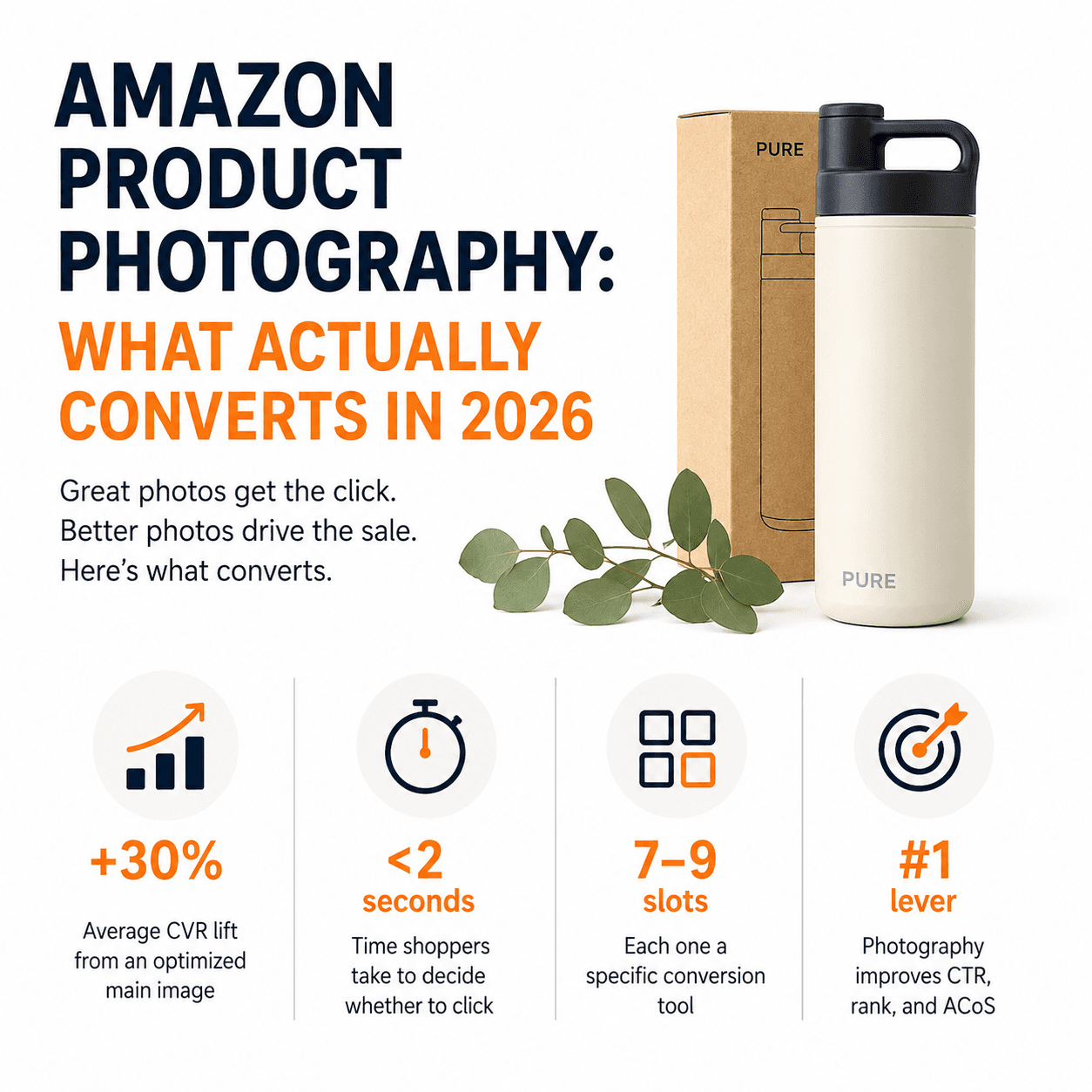
Your main image is your #1 conversion driver on Amazon. It determines whether a shopper clicks or scrolls past — and that single decision controls your CTR, your organic rank, and your effective ad spend. Poor photos waste every dirham you spend on PPC. Here's exactly what converts in 2026.
Stat | What It Means |
|---|---|
+30% | Average CVR lift from an optimized main image |
<2 seconds | Time shoppers take to decide whether to click |
7–9 slots | Each one a specific conversion tool |
#1 lever | Photography improves CTR, rank, and ACoS simultaneously |
Why Photography Is Your #1 Conversion Lever on Amazon
Amazon's algorithm ranks listings based on conversion rate and click-through rate — two metrics that your photography directly controls. This is the central feedback loop of the entire Amazon ranking system:
Better main image → higher CTR from search results and PPC placements
Higher CTR → better organic rank because Amazon reads it as a signal of relevance
Better secondary images → higher CVR because they answer objections before checkout
Higher CVR → lower effective ACoS because every click converts more efficiently
Lower ACoS → more budget to reinvest in scaling
This is why photography is not a marketing expense — it is infrastructure. The returns on a well-executed image stack compound across every impression your listing receives for as long as it ranks. Compare that to PPC spend, which delivers zero returns the moment you stop paying.
Most sellers dramatically underestimate how much of their PPC underperformance is actually a photography problem. The fix is not more ad spend. It's a better listing.
⚠️ The hidden cost of bad photos: If your main image has a 3% CTR and a competitor has a 6% CTR, Amazon reads your listing as half as relevant. Over time your organic ranking drops, your PPC CPCs rise to compensate, and your ACoS climbs. Bad photography doesn't just hurt conversion rate — it makes your entire advertising operation more expensive.
The 3-Second Rule: What Your Main Image Must Do
Your main image has one job and approximately two seconds to do it: make a shopper stop scrolling and click. That is the entire brief. Not beautiful. Not artistic. Not brand-forward. Clickable.
In Amazon search results, your main image is surrounded by competitors. Shoppers scan fast. The images that win clicks share specific characteristics that have nothing to do with aesthetics and everything to do with stopping power.
The 5 Main Image Rules That Win Clicks
1. Product fills 85%+ of the frame. Amazon's requirement is 85% but the best-performing images push even further. A product that fills the frame reads as larger, more premium, and more confident than one surrounded by dead space. At thumbnail size — where most shoppers first see your listing — every pixel counts.
2. Pure white background — no exceptions. Amazon requires it and it serves you. White background images have zero visual noise competing with your product. The only variable the shopper evaluates is your product itself.
3. The hero angle communicates the product instantly. A shopper should be able to identify what your product is within one second — without reading a word. If your main image requires interpretation, you've already lost the click to a competitor that doesn't.
4. No text, logos, or graphics on the main image. Amazon prohibits this and it hurts performance anyway. A clean, confident product shot outperforms a cluttered main image with feature callouts every time. Save the text for your secondary images.
5. Split test your main image before scaling PPC. Amazon's Manage Your Experiments tool lets Brand Registered sellers A/B test main images. Run at least two main image concepts and let the data decide — not your preferences. A 1% improvement in CTR compounds across millions of impressions over a year.
✅ Quick check: Pull up your listing in the Amazon mobile app and look at your main image at thumbnail size. Then look at your top 5 competitors at the same size. Which product do you want to click? That honest assessment tells you more than any analytics report.
The Image Job Framework: What Every Slot Should Accomplish
Amazon gives you 7–9 image slots. Most sellers treat them as an opportunity to show the product from different angles. High-converting listings treat each slot as a specific conversion tool with a defined job.
Image Slot | Job | Image Type | What It Answers |
|---|---|---|---|
Image 1 (Main) | Win the click | White background hero | "Is this what I'm looking for?" |
Image 2 | Establish scale & size | Hand hold or in-context | "How big is this actually?" |
Image 3 | Communicate top benefit | Lifestyle or infographic | "What does this do for me?" |
Image 4 | Handle the #1 objection | Detail shot or infographic | "Is it high quality / will it last?" |
Image 5 | Show it in real use | Lifestyle with model | "Can I see myself using this?" |
Image 6 | Differentiate from competitors | Comparison or feature grid | "Why this one vs the others?" |
Image 7 | Handle remaining objections | Detail shots / close-ups | "What are the exact specs / materials?" |
Images 8–9 | Build brand trust | Brand story / social proof | "Can I trust this brand?" |
This framework transforms your image stack from a gallery into a conversion funnel. Each image moves the shopper one step closer to Add to Cart by systematically answering the questions that stand between awareness and purchase.
The 6 Image Types Every High-Converting Stack Needs
White Background Hero Amazon-compliant pure white background. Product fills 85%+ of frame. Your main image — the single most important asset in your entire Amazon account. Image Slot 1
Lifestyle Photography Product in real-world context. Shows the customer what it feels like to own it — not just what it looks like. Builds emotional desire that specs alone cannot create. Slots 3, 5
Model Photography Human context creates scale, aspiration, and relatability. Essential for apparel, beauty, fitness, and any product where the buyer needs to see themselves using it. Slot 5
Infographic / Benefit Images Feature callouts and benefit statements layered over a product shot. Communicates what takes 200 words in bullets to say — in one glance. Mobile shoppers read these; they rarely read bullets. Slots 3, 4, 6
Hand Hold / Scale Shot The most underused image type on Amazon. Hands provide instant, universal size reference. Removes the size uncertainty that leads to returns and negative reviews. Slot 2
Detail / Close-Up Shots Material quality, stitching, texture, finish — details that communicate premium quality and answer the "is it actually good?" question every buyer asks before purchasing. Slot 7
Lifestyle Photography: The Highest-ROI Secondary Image
If you have a limited budget and can only invest in one type of secondary imagery beyond your white background hero, invest in lifestyle photography. Here's why it consistently outperforms every other image type for conversion rate improvement.
Static pack shots tell shoppers what a product is. Lifestyle images show shoppers what a product does for them. That shift — from information to aspiration — is what moves the needle on conversion rate. Shoppers don't buy products; they buy outcomes, identities, and feelings.
What makes lifestyle photography convert on Amazon:
Realistic environments, not staged studios. A kitchen that looks like someone actually cooks in it outperforms a spotless showroom kitchen. Authenticity builds trust. Over-polished lifestyle images read as stock photography and shoppers tune them out.
Models who match your target customer. If your target buyer is a 35-year-old woman who works out, your lifestyle model should reflect that. The shopper should see themselves in the image. Demographic alignment directly impacts conversion.
Product in active use, not just displayed. Show the product being used — not posed next to it. Someone using your kitchen knife to slice vegetables converts better than the same knife displayed on a cutting board. Active use communicates competence and desirability simultaneously.
Lighting that feels natural, not commercial. Natural light or warm artificial light outperforms harsh studio lighting for lifestyle shots. The goal is authentic and aspirational — not "this was taken in a photography studio."
Middle East-specific consideration: Lifestyle imagery for Amazon.ae and Amazon.sa requires additional thought. For KSA listings especially, imagery should reflect local cultural context — modest styling where relevant, local environmental settings (desert, urban Gulf architecture, home environments recognizable to regional buyers), and Arabic text overlays on infographic images. A lifestyle image that resonates with a UK shopper may not resonate with a Saudi shopper. When briefing lifestyle shoots for the Middle East market, build this in from the start rather than adapting later.
AI Product Photography in 2026: When It Works and When It Doesn't
AI-generated product photography has matured significantly in 2026 and is now a legitimate part of a smart content strategy — but only in the right role.
Where AI excels: Background replacement and lifestyle scene generation at scale. Take a high-quality real photo of your product and AI can place it convincingly in dozens of different environments — a kitchen countertop, an outdoor patio, a bathroom shelf. This gives you lifestyle variety at a fraction of the cost of traditional shoots.
Where AI still struggles: Products that require genuine human interaction, products with complex reflective surfaces, products where hands or people are the key context (AI hands are improving but still imperfect), and any situation where authenticity is paramount. AI images can still look synthetic to trained eyes.
The right workflow: Shoot real white background hero images and in-hand shots with a professional photographer. Use those as source assets for AI expansion into lifestyle environments. You get the quality of real photography combined with the volume and variety of AI generation. AI cannot replace the original shoot — but it dramatically multiplies what one shoot produces.
Bottom line: Use AI to scale content variety, not to cut corners on your core assets. Your main image, your hand-hold shots, and your primary lifestyle images should always be real photography. Use AI to fill the remaining image slots with additional lifestyle variants at a lower cost.
Split Testing Your Images: The Only Way to Actually Know What Converts
Every photographer and every brand has opinions about what converts. The only opinion that matters is Amazon's data. Amazon's Manage Your Experiments tool gives Brand Registered sellers the ability to A/B test main images, titles, and A+ content against real traffic — and it's one of the most underused tools in Seller Central.
How to run an Amazon image A/B test:
1. Create two genuinely different concepts — not variations. Testing a white background vs a slightly different white background won't produce useful data. Test meaningfully different approaches — pure product vs product with hand hold, different hero angles, different orientations. Meaningful variation produces meaningful data.
2. Run the test for a minimum of 4 weeks. Amazon recommends at least 4 weeks to reach statistical significance. Tests ended early produce false results. Resist the urge to call a winner before the data is ready.
3. Measure CVR and CTR — not just sales. A main image test should be evaluated on click-through rate and conversion rate. Total sales are affected by too many variables. CVR and CTR isolate the image's specific contribution.
4. Implement the winner and move to the next test. Continuous testing compounds over time. A brand that tests one image element per quarter improves conversion rate faster than one that tests once and stops. Build testing into your quarterly content calendar.
💡 Data point: A 1% improvement in CTR on a listing receiving 10,000 impressions per month generates 100 additional clicks. At a 15% CVR, that's 15 additional sales per month — purely from the image change, with zero additional ad spend. Over 12 months: 180 additional sales. Photography ROI is not theoretical. It is measurable.
The 7 Amazon Photography Mistakes That Kill Conversions
Mistake | Why It Hurts | The Fix |
|---|---|---|
Product too small in frame | Low confidence signal, hard to evaluate at thumbnail size | Fill 85%+ of frame — more is better |
Off-white or grey background | Looks amateurish, fails Amazon compliance | Pure white only: RGB 255,255,255 |
Blurry or low resolution | Shoppers can't zoom — damages trust immediately | Minimum 1000px on longest side for zoom |
No lifestyle or context images | Shopper can't visualize ownership or use | At least 2 lifestyle shots per listing |
Stock photography | Generic, untrustworthy, brand-destroying | Real product, real environments only |
Ignoring mobile | 75%+ of Middle East Amazon traffic is mobile | Test every image on a phone before publishing |
Never split testing | Leaving measurable conversion gains on the table | Test at least one image element per quarter |
Frequently Asked Questions
How many product images do I need for an Amazon listing? Fill every single slot Amazon gives you — 7 to 9 depending on your category and Brand Registry status. Each empty slot is a missed conversion opportunity. At minimum: 1 white background main image, 1 scale/hand hold shot, 2 lifestyle images, 2 infographic/benefit images, and 1 detail shot.
What makes a good Amazon main image? A good main image does one thing well: it earns the click in search results. The product should fill 85%+ of the frame on a pure white background. The hero angle should communicate what the product is instantly at thumbnail size. No text, no logos, no graphics. The goal is not beautiful — it is clickable. Test at least two main image concepts and let Amazon's data tell you which one wins.
Should my main image be white background or lifestyle? Amazon requires white background for main images in most categories. Some categories allow lifestyle main images — if yours does, test both. Some products perform significantly better with a lifestyle main (apparel, home décor, beauty) while others perform better with a pure product shot (electronics, tools, supplements). A/B test using Manage Your Experiments and let the data decide.
How does photography affect my Amazon PPC performance? Directly and significantly. Your main image controls your CTR in PPC placements. A higher CTR means Amazon rewards your ads with better placement at lower cost. A higher CVR means your spend converts more efficiently — lowering your effective ACoS. Many sellers think they have a PPC problem when they actually have a photography problem. Fix the listing first, then scale the ads.
Is AI product photography good enough for Amazon in 2026? AI photography works well for lifestyle background expansion — placing a real product photo into AI-generated environments. It does not replace the original product shoot. Main images and any images featuring human context should be real photography. AI works best as a multiplier on top of real photography, not as a substitute for it.
What is the minimum image size for Amazon product photos? Amazon requires at least 500px on the longest side, but recommends 1000px minimum to enable the zoom function. Zoom is critical — shoppers who zoom on a product image convert at higher rates than those who don't. Deliver images at 2000px+ on the longest side for the best zoom quality.
Does image quality matter more on Amazon.ae and Amazon.sa than on Amazon.com? Yes — for a specific reason. Amazon.ae and Amazon.sa are newer platforms and buyer trust in unfamiliar sellers is lower than on Amazon.com. High-quality imagery is one of the fastest ways to close that trust gap. A listing with professional photography signals that the seller is serious and invested in their product — which matters more on platforms where shoppers are still building purchasing habits.
Ready to Fix What's Holding Your Listing Back?
Most Amazon sellers in the UAE and KSA are running ads to listings with photography that was never built to convert the Middle East market. The gap between a default listing and one with a proper image stack — culturally relevant lifestyle shots, Arabic text overlays, mobile-optimized infographics — is one of the clearest competitive advantages still available on Amazon.ae and Amazon.sa.
Sellers Society works with Middle East-based sellers on Amazon.ae, Amazon.sa, and other marketplaces to identify exactly what's holding your listings back and build a plan to fix it.
Book A Free Call
Sellers Society | Amazon & Marketplace Seller Agency
Your main image is your #1 conversion driver on Amazon. It determines whether a shopper clicks or scrolls past — and that single decision controls your CTR, your organic rank, and your effective ad spend. Poor photos waste every dirham you spend on PPC. Here's exactly what converts in 2026.
Stat | What It Means |
|---|---|
+30% | Average CVR lift from an optimized main image |
<2 seconds | Time shoppers take to decide whether to click |
7–9 slots | Each one a specific conversion tool |
#1 lever | Photography improves CTR, rank, and ACoS simultaneously |
Why Photography Is Your #1 Conversion Lever on Amazon
Amazon's algorithm ranks listings based on conversion rate and click-through rate — two metrics that your photography directly controls. This is the central feedback loop of the entire Amazon ranking system:
Better main image → higher CTR from search results and PPC placements
Higher CTR → better organic rank because Amazon reads it as a signal of relevance
Better secondary images → higher CVR because they answer objections before checkout
Higher CVR → lower effective ACoS because every click converts more efficiently
Lower ACoS → more budget to reinvest in scaling
This is why photography is not a marketing expense — it is infrastructure. The returns on a well-executed image stack compound across every impression your listing receives for as long as it ranks. Compare that to PPC spend, which delivers zero returns the moment you stop paying.
Most sellers dramatically underestimate how much of their PPC underperformance is actually a photography problem. The fix is not more ad spend. It's a better listing.
⚠️ The hidden cost of bad photos: If your main image has a 3% CTR and a competitor has a 6% CTR, Amazon reads your listing as half as relevant. Over time your organic ranking drops, your PPC CPCs rise to compensate, and your ACoS climbs. Bad photography doesn't just hurt conversion rate — it makes your entire advertising operation more expensive.
The 3-Second Rule: What Your Main Image Must Do
Your main image has one job and approximately two seconds to do it: make a shopper stop scrolling and click. That is the entire brief. Not beautiful. Not artistic. Not brand-forward. Clickable.
In Amazon search results, your main image is surrounded by competitors. Shoppers scan fast. The images that win clicks share specific characteristics that have nothing to do with aesthetics and everything to do with stopping power.
The 5 Main Image Rules That Win Clicks
1. Product fills 85%+ of the frame. Amazon's requirement is 85% but the best-performing images push even further. A product that fills the frame reads as larger, more premium, and more confident than one surrounded by dead space. At thumbnail size — where most shoppers first see your listing — every pixel counts.
2. Pure white background — no exceptions. Amazon requires it and it serves you. White background images have zero visual noise competing with your product. The only variable the shopper evaluates is your product itself.
3. The hero angle communicates the product instantly. A shopper should be able to identify what your product is within one second — without reading a word. If your main image requires interpretation, you've already lost the click to a competitor that doesn't.
4. No text, logos, or graphics on the main image. Amazon prohibits this and it hurts performance anyway. A clean, confident product shot outperforms a cluttered main image with feature callouts every time. Save the text for your secondary images.
5. Split test your main image before scaling PPC. Amazon's Manage Your Experiments tool lets Brand Registered sellers A/B test main images. Run at least two main image concepts and let the data decide — not your preferences. A 1% improvement in CTR compounds across millions of impressions over a year.
✅ Quick check: Pull up your listing in the Amazon mobile app and look at your main image at thumbnail size. Then look at your top 5 competitors at the same size. Which product do you want to click? That honest assessment tells you more than any analytics report.
The Image Job Framework: What Every Slot Should Accomplish
Amazon gives you 7–9 image slots. Most sellers treat them as an opportunity to show the product from different angles. High-converting listings treat each slot as a specific conversion tool with a defined job.
Image Slot | Job | Image Type | What It Answers |
|---|---|---|---|
Image 1 (Main) | Win the click | White background hero | "Is this what I'm looking for?" |
Image 2 | Establish scale & size | Hand hold or in-context | "How big is this actually?" |
Image 3 | Communicate top benefit | Lifestyle or infographic | "What does this do for me?" |
Image 4 | Handle the #1 objection | Detail shot or infographic | "Is it high quality / will it last?" |
Image 5 | Show it in real use | Lifestyle with model | "Can I see myself using this?" |
Image 6 | Differentiate from competitors | Comparison or feature grid | "Why this one vs the others?" |
Image 7 | Handle remaining objections | Detail shots / close-ups | "What are the exact specs / materials?" |
Images 8–9 | Build brand trust | Brand story / social proof | "Can I trust this brand?" |
This framework transforms your image stack from a gallery into a conversion funnel. Each image moves the shopper one step closer to Add to Cart by systematically answering the questions that stand between awareness and purchase.
The 6 Image Types Every High-Converting Stack Needs
White Background Hero Amazon-compliant pure white background. Product fills 85%+ of frame. Your main image — the single most important asset in your entire Amazon account. Image Slot 1
Lifestyle Photography Product in real-world context. Shows the customer what it feels like to own it — not just what it looks like. Builds emotional desire that specs alone cannot create. Slots 3, 5
Model Photography Human context creates scale, aspiration, and relatability. Essential for apparel, beauty, fitness, and any product where the buyer needs to see themselves using it. Slot 5
Infographic / Benefit Images Feature callouts and benefit statements layered over a product shot. Communicates what takes 200 words in bullets to say — in one glance. Mobile shoppers read these; they rarely read bullets. Slots 3, 4, 6
Hand Hold / Scale Shot The most underused image type on Amazon. Hands provide instant, universal size reference. Removes the size uncertainty that leads to returns and negative reviews. Slot 2
Detail / Close-Up Shots Material quality, stitching, texture, finish — details that communicate premium quality and answer the "is it actually good?" question every buyer asks before purchasing. Slot 7
Lifestyle Photography: The Highest-ROI Secondary Image
If you have a limited budget and can only invest in one type of secondary imagery beyond your white background hero, invest in lifestyle photography. Here's why it consistently outperforms every other image type for conversion rate improvement.
Static pack shots tell shoppers what a product is. Lifestyle images show shoppers what a product does for them. That shift — from information to aspiration — is what moves the needle on conversion rate. Shoppers don't buy products; they buy outcomes, identities, and feelings.
What makes lifestyle photography convert on Amazon:
Realistic environments, not staged studios. A kitchen that looks like someone actually cooks in it outperforms a spotless showroom kitchen. Authenticity builds trust. Over-polished lifestyle images read as stock photography and shoppers tune them out.
Models who match your target customer. If your target buyer is a 35-year-old woman who works out, your lifestyle model should reflect that. The shopper should see themselves in the image. Demographic alignment directly impacts conversion.
Product in active use, not just displayed. Show the product being used — not posed next to it. Someone using your kitchen knife to slice vegetables converts better than the same knife displayed on a cutting board. Active use communicates competence and desirability simultaneously.
Lighting that feels natural, not commercial. Natural light or warm artificial light outperforms harsh studio lighting for lifestyle shots. The goal is authentic and aspirational — not "this was taken in a photography studio."
Middle East-specific consideration: Lifestyle imagery for Amazon.ae and Amazon.sa requires additional thought. For KSA listings especially, imagery should reflect local cultural context — modest styling where relevant, local environmental settings (desert, urban Gulf architecture, home environments recognizable to regional buyers), and Arabic text overlays on infographic images. A lifestyle image that resonates with a UK shopper may not resonate with a Saudi shopper. When briefing lifestyle shoots for the Middle East market, build this in from the start rather than adapting later.
AI Product Photography in 2026: When It Works and When It Doesn't
AI-generated product photography has matured significantly in 2026 and is now a legitimate part of a smart content strategy — but only in the right role.
Where AI excels: Background replacement and lifestyle scene generation at scale. Take a high-quality real photo of your product and AI can place it convincingly in dozens of different environments — a kitchen countertop, an outdoor patio, a bathroom shelf. This gives you lifestyle variety at a fraction of the cost of traditional shoots.
Where AI still struggles: Products that require genuine human interaction, products with complex reflective surfaces, products where hands or people are the key context (AI hands are improving but still imperfect), and any situation where authenticity is paramount. AI images can still look synthetic to trained eyes.
The right workflow: Shoot real white background hero images and in-hand shots with a professional photographer. Use those as source assets for AI expansion into lifestyle environments. You get the quality of real photography combined with the volume and variety of AI generation. AI cannot replace the original shoot — but it dramatically multiplies what one shoot produces.
Bottom line: Use AI to scale content variety, not to cut corners on your core assets. Your main image, your hand-hold shots, and your primary lifestyle images should always be real photography. Use AI to fill the remaining image slots with additional lifestyle variants at a lower cost.
Split Testing Your Images: The Only Way to Actually Know What Converts
Every photographer and every brand has opinions about what converts. The only opinion that matters is Amazon's data. Amazon's Manage Your Experiments tool gives Brand Registered sellers the ability to A/B test main images, titles, and A+ content against real traffic — and it's one of the most underused tools in Seller Central.
How to run an Amazon image A/B test:
1. Create two genuinely different concepts — not variations. Testing a white background vs a slightly different white background won't produce useful data. Test meaningfully different approaches — pure product vs product with hand hold, different hero angles, different orientations. Meaningful variation produces meaningful data.
2. Run the test for a minimum of 4 weeks. Amazon recommends at least 4 weeks to reach statistical significance. Tests ended early produce false results. Resist the urge to call a winner before the data is ready.
3. Measure CVR and CTR — not just sales. A main image test should be evaluated on click-through rate and conversion rate. Total sales are affected by too many variables. CVR and CTR isolate the image's specific contribution.
4. Implement the winner and move to the next test. Continuous testing compounds over time. A brand that tests one image element per quarter improves conversion rate faster than one that tests once and stops. Build testing into your quarterly content calendar.
💡 Data point: A 1% improvement in CTR on a listing receiving 10,000 impressions per month generates 100 additional clicks. At a 15% CVR, that's 15 additional sales per month — purely from the image change, with zero additional ad spend. Over 12 months: 180 additional sales. Photography ROI is not theoretical. It is measurable.
The 7 Amazon Photography Mistakes That Kill Conversions
Mistake | Why It Hurts | The Fix |
|---|---|---|
Product too small in frame | Low confidence signal, hard to evaluate at thumbnail size | Fill 85%+ of frame — more is better |
Off-white or grey background | Looks amateurish, fails Amazon compliance | Pure white only: RGB 255,255,255 |
Blurry or low resolution | Shoppers can't zoom — damages trust immediately | Minimum 1000px on longest side for zoom |
No lifestyle or context images | Shopper can't visualize ownership or use | At least 2 lifestyle shots per listing |
Stock photography | Generic, untrustworthy, brand-destroying | Real product, real environments only |
Ignoring mobile | 75%+ of Middle East Amazon traffic is mobile | Test every image on a phone before publishing |
Never split testing | Leaving measurable conversion gains on the table | Test at least one image element per quarter |
Frequently Asked Questions
How many product images do I need for an Amazon listing? Fill every single slot Amazon gives you — 7 to 9 depending on your category and Brand Registry status. Each empty slot is a missed conversion opportunity. At minimum: 1 white background main image, 1 scale/hand hold shot, 2 lifestyle images, 2 infographic/benefit images, and 1 detail shot.
What makes a good Amazon main image? A good main image does one thing well: it earns the click in search results. The product should fill 85%+ of the frame on a pure white background. The hero angle should communicate what the product is instantly at thumbnail size. No text, no logos, no graphics. The goal is not beautiful — it is clickable. Test at least two main image concepts and let Amazon's data tell you which one wins.
Should my main image be white background or lifestyle? Amazon requires white background for main images in most categories. Some categories allow lifestyle main images — if yours does, test both. Some products perform significantly better with a lifestyle main (apparel, home décor, beauty) while others perform better with a pure product shot (electronics, tools, supplements). A/B test using Manage Your Experiments and let the data decide.
How does photography affect my Amazon PPC performance? Directly and significantly. Your main image controls your CTR in PPC placements. A higher CTR means Amazon rewards your ads with better placement at lower cost. A higher CVR means your spend converts more efficiently — lowering your effective ACoS. Many sellers think they have a PPC problem when they actually have a photography problem. Fix the listing first, then scale the ads.
Is AI product photography good enough for Amazon in 2026? AI photography works well for lifestyle background expansion — placing a real product photo into AI-generated environments. It does not replace the original product shoot. Main images and any images featuring human context should be real photography. AI works best as a multiplier on top of real photography, not as a substitute for it.
What is the minimum image size for Amazon product photos? Amazon requires at least 500px on the longest side, but recommends 1000px minimum to enable the zoom function. Zoom is critical — shoppers who zoom on a product image convert at higher rates than those who don't. Deliver images at 2000px+ on the longest side for the best zoom quality.
Does image quality matter more on Amazon.ae and Amazon.sa than on Amazon.com? Yes — for a specific reason. Amazon.ae and Amazon.sa are newer platforms and buyer trust in unfamiliar sellers is lower than on Amazon.com. High-quality imagery is one of the fastest ways to close that trust gap. A listing with professional photography signals that the seller is serious and invested in their product — which matters more on platforms where shoppers are still building purchasing habits.
Ready to Fix What's Holding Your Listing Back?
Most Amazon sellers in the UAE and KSA are running ads to listings with photography that was never built to convert the Middle East market. The gap between a default listing and one with a proper image stack — culturally relevant lifestyle shots, Arabic text overlays, mobile-optimized infographics — is one of the clearest competitive advantages still available on Amazon.ae and Amazon.sa.
Sellers Society works with Middle East-based sellers on Amazon.ae, Amazon.sa, and other marketplaces to identify exactly what's holding your listings back and build a plan to fix it.
Book A Free Call
Sellers Society | Amazon & Marketplace Seller Agency
Ready to grow your Amazon business with Expert Guidance?
Join 1000+ growing network of Amazon entrepreneurs building real, profitable brands.
THINK
BIG!
SELL
BIGGER!!





sellerssociety©️2026
All Rights Reserved
Ready to grow your Amazon business with Expert Guidance?
Join 1000+ growing network of Amazon entrepreneurs building real, profitable brands.
THINK
BIG!
SELL
BIGGER!!
sellerssociety©️2026
All Rights Reserved
Ready to grow your Amazon business with Expert Guidance?
Join 1000+ growing network of Amazon entrepreneurs building real, profitable brands.
THINK
BIG!
SELL
BIGGER!!
sellerssociety©️2026
All Rights Reserved