
Basics
Amazon Private Label: How to Build Your Own Brand
Amazon Private Label: How to Build Your Own Brand
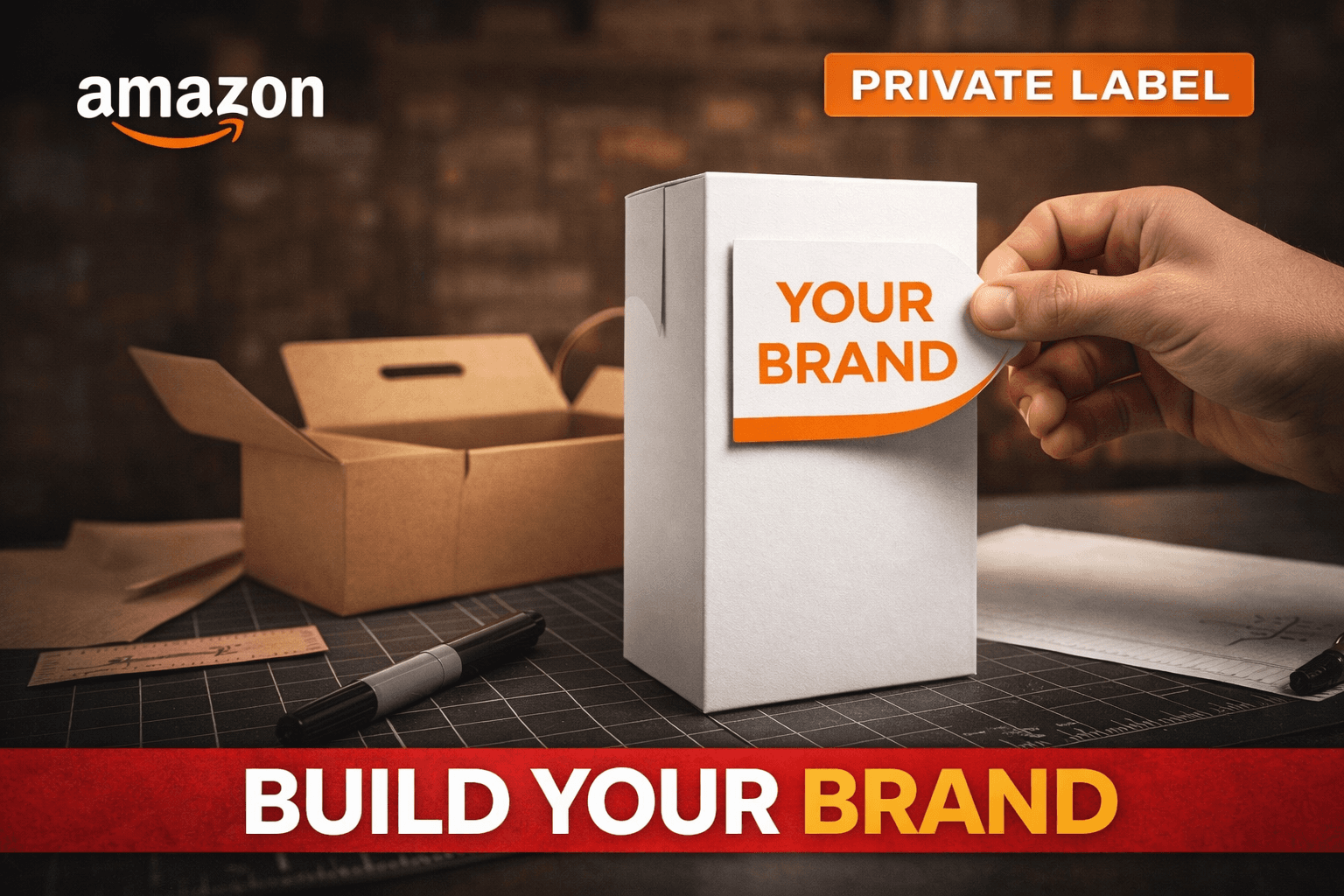
Private labelling on Amazon is one of several business models available to sellers, allowing you to build and sell products under your own brand. It provides control over branding, pricing, margins, and overall long term business value. Unlike reselling other people's products, private label means the brand is owned and managed by you.
Whether you're exploring Amazon private label for the first time or evaluating it as a long term business model, this guide covers how the process works, what to expect at each stage, and the key considerations involved in building a brand on Amazon.
If you're new to selling on Amazon entirely, our complete guide to selling on Amazon covers the broader fundamentals before diving into private label specifically.
What Private Label Means in Practice
In simple terms, private label involves sourcing a product from a manufacturer, adding your own branding (logo, packaging, labels), and selling it under your own brand name on Amazon.
You're not manufacturing the product yourself. Instead, you're working with existing manufacturers to produce a product to your specifications, with your brand on it.
The manufacturer makes the product, but the brand is yours. This is how many consumer brands operate, including both established brands and niche Amazon sellers.
Why Sellers Choose Private Label Over Other Models
Compared to other Amazon selling models (wholesale, arbitrage), private label offers several distinct advantages. For those looking to start selling on Amazon, understanding these differences is often one of the first steps:
Brand ownership: You own the brand, the listings, and the customer relationship. Other sellers cannot list the same product under your brand.
Higher margins: Because you're buying directly from manufacturers and selling under your own brand, margins can vary, but many sellers aim for 30 to 50% depending on costs and competition.
Long term value: A successful private label brand has real business value. It can be sold, licensed, or expanded into new product categories.
Control: You control pricing, listing content, advertising strategy, and product development. No dependence on another brand's decisions.
Amazon Brand Registry: With a registered trademark, you can enroll in Amazon's Brand Registry, which gives you access to A+ Content, Brand Analytics, and brand protection tools.
How to Choose a Niche You Can Actually Compete In
Start by looking for a product category where you can realistically compete. Consider the following:
Consistent demand: Products that sell steadily year-round, not seasonal spikes.
Moderate competition: Categories where the top sellers have strong sales but imperfect listings (poor images, weak copy, few reviews under 100).
Room for improvement: Can you offer a better version? Better quality, added features, better packaging, or a better brand experience.
Good margins: After product cost, shipping, Amazon fees, and advertising, you need at least 25 to 30% net margin.
Use product research tools (Helium 10, Jungle Scout) to analyze demand, competition, and profitability before committing.
Finding and Managing Reliable Suppliers
Alibaba is the most common platform for finding private label manufacturers. Here's the process:
Search for your product type on Alibaba
Filter for "Verified Suppliers" and "Trade Assurance"
Contact 5 to 10 suppliers with your product brief (specifications, quantity, packaging requirements, branding requirements)
Request samples from your top 3 to 5 choices
Compare suppliers based on quality, communication, pricing, and overall reliability
Negotiate terms with your preferred supplier
Key negotiation points:
Unit price (typically decreases with higher quantities)
MOQ (minimum order quantity): try to negotiate down for your first order
Payment terms (common: 30% deposit, 70% before shipping)
Lead time (how long from order to delivery)
Customization options (colors, materials, sizes)
Communication delays are common, especially when working across time zones, so response speed can be a useful indicator of supplier reliability. Product quality can also vary between samples and full production runs, which is why inspections are important before shipping.
Always use a third-party quality inspection service before your products ship. This typically costs a few hundred dollars and helps prevent defective inventory from reaching Amazon.
What Goes Into Building a Private Label Brand
Your brand is more than a logo. It's the entire experience a customer has with your product. Many private label brands fail not because of the product itself, but because they look indistinguishable from competitors. Small details such as packaging quality, positioning, and perceived value can influence how customers respond.
Brand name: Choose something memorable, easy to spell, and relevant to your niche. Check trademark availability before committing.
Logo: Get a professional logo designed. Keep it clean and simple. Fiverr, 99designs, or a local graphic designer can produce quality work.
Packaging: Your packaging is part of your brand experience. Invest in quality packaging that:
Protects the product
Looks professional and appealing
Includes your brand name, logo, and key product information
Differentiates you from competitors
Brand story: Why does your brand exist? What problem does it solve? What makes it different? A compelling brand story builds emotional connection with customers.
Trademark registration: Register your brand name as a trademark. This takes several months but enables Amazon Brand Registry, which unlocks powerful tools and protection.
What Makes a Private Label Listing Convert
Your listing is your main sales interface, and its effectiveness depends on how clearly it communicates value and addresses customer concerns. With private label, you control every part of the listing.
Title: Include your brand name and primary keyword. Be descriptive but concise.
Images: Professional product photography plays a significant role in conversion and is generally expected in competitive categories. Include white background shots, lifestyle images, infographics, and detail shots. Minimum 7 images.
Bullet points: Focus on benefits. Address the customer's questions and concerns. Differentiate from competitors.
A+ Content: If you're Brand Registered, create A+ Content with branded images, comparison charts, and your brand story. This can increase conversion by 3 to 10%.
Backend keywords: Include relevant search terms that don't appear in your visible listing.
What to Expect When Launching a New Product
A new private label product has zero reviews, zero sales history, and no organic ranking. Your launch strategy bridges this gap. New listings often require sustained advertising spend before achieving stable rankings. Early performance can fluctuate as Amazon tests visibility, and it can take several weeks before results begin to stabilize.
Amazon PPC: Start with Sponsored Products campaigns. Run automatic campaigns for keyword discovery, then build manual campaigns targeting your best keywords.
Launch pricing: Consider launching at a slightly lower price point to drive initial sales velocity. You can increase prices once you've built reviews and ranking.
Promotions and coupons: Amazon's coupon feature can increase click-through rates and drive initial sales.
Reviews: Use Amazon's "Request a Review" button for every order. Reviews build social proof and significantly impact conversion rates.
External traffic: Drive traffic from social media, email lists, or influencer partnerships. External traffic signals tell Amazon your product has broader demand.
Improving Performance and Scaling What Works
Once you start seeing sales data, ongoing optimization becomes essential:
PPC optimization: Review search term reports weekly. Add converting terms to manual campaigns, add negatives for non-converting terms, adjust bids based on ACoS.
Listing optimization: Monitor conversion rate in Business Reports. Test different main images, adjust pricing, refine bullet points based on customer feedback.
Review management: Address negative reviews by improving your product or listing. Respond to customer questions promptly.
Inventory management: Forecast demand based on sales velocity and lead times. Avoid stockouts: they destroy your ranking momentum.
Product line expansion: Once your first product is established, launch complementary products within the same niche. This helps strengthen your brand while creating opportunities to cross-sell.
How to Evaluate Whether a Product Is Worth Launching
When evaluating a private label opportunity, several factors can indicate whether a product is worth pursuing. Consistent demand is important, but it should be supported by realistic competition levels rather than dominated by a few established brands. Product listings with weak images, unclear descriptions, or low review counts may suggest room for improvement.
It's important to look closely at margins by factoring in manufacturing, shipping, Amazon fees, and advertising costs rather than relying on supplier pricing alone. You should also consider whether the product can be meaningfully differentiated through quality, packaging, or functionality.
Red flags include highly saturated markets, products with frequent quality complaints in reviews, and items that are difficult to ship or regulate. A balanced evaluation helps reduce risk before committing to inventory.
Building Long Term Brand Value
A single successful product is a good starting point, but long term value comes from building a recognizable brand that customers return to. The most valuable private label businesses go beyond individual products:
Brand Registry: Enroll as soon as you have a trademark. This protects your brand and gives you access to powerful tools.
Brand Store: Create an Amazon Brand Store (a free, multi-page storefront within Amazon). This gives customers a branded shopping experience and provides a landing page for your Sponsored Brands campaigns.
Multi-channel expansion: Once established on Amazon, consider expanding to your own website (Shopify), other marketplaces (Noon), and even retail.
Brand community: Build a following on social media. Engage with customers. Create content that adds value beyond just selling products.
Common Mistakes
Rushing product research: This often leads to entering saturated markets where advertising costs make profitability difficult.
Choosing price over quality: Lower-quality products often lead to negative reviews, which can quickly affect conversion rates and rankings.
Ignoring the brand: A logo on a generic product is not enough to differentiate. Without clear packaging, messaging, and positioning, customers have no reason to choose your product over similar options.
Launching without advertising: New products have no visibility by default. Without PPC campaigns driving initial traffic, most listings struggle to gain traction or generate early reviews.
Not protecting your brand: Without Brand Registry and a trademark, competitors can hijack your listing or copy your products.
Final Thoughts
Private label offers a structured way to build a brand using existing manufacturing systems, but success depends on careful product selection, consistent execution, and ongoing optimization. For sellers willing to approach it methodically, it can become more than a single product and develop into a broader brand over time. Some sellers choose structured programs, such as an Amazon FBA accelerator program, to shorten the learning curve and avoid common mistakes.
Frequently Asked Questions
Is private label still profitable on Amazon?
Profitability depends on product selection, cost control, and competition. While opportunities still exist, margins can be affected by rising advertising costs and increased competition.
How much does it cost to start a private label business?
Costs vary, but initial investment often includes product samples, inventory, shipping, branding, and advertising. Many sellers start with a few thousand dollars, though this depends on the product category.
How long does it take to see results?
It can take several months to launch a product, gather reviews, and achieve stable rankings. Results are rarely immediate and require ongoing optimisation.
Do you need a trademark to start?
You can start without one, but a registered trademark is required to access Amazon Brand Registry, which provides additional tools and protection. The registration process can take several months, so it is worth starting early.
What are the main risks of starting a private label business?
Common risks include poor product selection, quality issues, supplier problems, and underestimating advertising costs.
How do you know if a private label product is too competitive?
A product may be too competitive if top listings are dominated by established brands with high review counts and strong listings. If there is little room to differentiate or compete without heavy advertising, it may be difficult to gain traction.
Private labelling on Amazon is one of several business models available to sellers, allowing you to build and sell products under your own brand. It provides control over branding, pricing, margins, and overall long term business value. Unlike reselling other people's products, private label means the brand is owned and managed by you.
Whether you're exploring Amazon private label for the first time or evaluating it as a long term business model, this guide covers how the process works, what to expect at each stage, and the key considerations involved in building a brand on Amazon.
If you're new to selling on Amazon entirely, our complete guide to selling on Amazon covers the broader fundamentals before diving into private label specifically.
What Private Label Means in Practice
In simple terms, private label involves sourcing a product from a manufacturer, adding your own branding (logo, packaging, labels), and selling it under your own brand name on Amazon.
You're not manufacturing the product yourself. Instead, you're working with existing manufacturers to produce a product to your specifications, with your brand on it.
The manufacturer makes the product, but the brand is yours. This is how many consumer brands operate, including both established brands and niche Amazon sellers.
Why Sellers Choose Private Label Over Other Models
Compared to other Amazon selling models (wholesale, arbitrage), private label offers several distinct advantages. For those looking to start selling on Amazon, understanding these differences is often one of the first steps:
Brand ownership: You own the brand, the listings, and the customer relationship. Other sellers cannot list the same product under your brand.
Higher margins: Because you're buying directly from manufacturers and selling under your own brand, margins can vary, but many sellers aim for 30 to 50% depending on costs and competition.
Long term value: A successful private label brand has real business value. It can be sold, licensed, or expanded into new product categories.
Control: You control pricing, listing content, advertising strategy, and product development. No dependence on another brand's decisions.
Amazon Brand Registry: With a registered trademark, you can enroll in Amazon's Brand Registry, which gives you access to A+ Content, Brand Analytics, and brand protection tools.
How to Choose a Niche You Can Actually Compete In
Start by looking for a product category where you can realistically compete. Consider the following:
Consistent demand: Products that sell steadily year-round, not seasonal spikes.
Moderate competition: Categories where the top sellers have strong sales but imperfect listings (poor images, weak copy, few reviews under 100).
Room for improvement: Can you offer a better version? Better quality, added features, better packaging, or a better brand experience.
Good margins: After product cost, shipping, Amazon fees, and advertising, you need at least 25 to 30% net margin.
Use product research tools (Helium 10, Jungle Scout) to analyze demand, competition, and profitability before committing.
Finding and Managing Reliable Suppliers
Alibaba is the most common platform for finding private label manufacturers. Here's the process:
Search for your product type on Alibaba
Filter for "Verified Suppliers" and "Trade Assurance"
Contact 5 to 10 suppliers with your product brief (specifications, quantity, packaging requirements, branding requirements)
Request samples from your top 3 to 5 choices
Compare suppliers based on quality, communication, pricing, and overall reliability
Negotiate terms with your preferred supplier
Key negotiation points:
Unit price (typically decreases with higher quantities)
MOQ (minimum order quantity): try to negotiate down for your first order
Payment terms (common: 30% deposit, 70% before shipping)
Lead time (how long from order to delivery)
Customization options (colors, materials, sizes)
Communication delays are common, especially when working across time zones, so response speed can be a useful indicator of supplier reliability. Product quality can also vary between samples and full production runs, which is why inspections are important before shipping.
Always use a third-party quality inspection service before your products ship. This typically costs a few hundred dollars and helps prevent defective inventory from reaching Amazon.
What Goes Into Building a Private Label Brand
Your brand is more than a logo. It's the entire experience a customer has with your product. Many private label brands fail not because of the product itself, but because they look indistinguishable from competitors. Small details such as packaging quality, positioning, and perceived value can influence how customers respond.
Brand name: Choose something memorable, easy to spell, and relevant to your niche. Check trademark availability before committing.
Logo: Get a professional logo designed. Keep it clean and simple. Fiverr, 99designs, or a local graphic designer can produce quality work.
Packaging: Your packaging is part of your brand experience. Invest in quality packaging that:
Protects the product
Looks professional and appealing
Includes your brand name, logo, and key product information
Differentiates you from competitors
Brand story: Why does your brand exist? What problem does it solve? What makes it different? A compelling brand story builds emotional connection with customers.
Trademark registration: Register your brand name as a trademark. This takes several months but enables Amazon Brand Registry, which unlocks powerful tools and protection.
What Makes a Private Label Listing Convert
Your listing is your main sales interface, and its effectiveness depends on how clearly it communicates value and addresses customer concerns. With private label, you control every part of the listing.
Title: Include your brand name and primary keyword. Be descriptive but concise.
Images: Professional product photography plays a significant role in conversion and is generally expected in competitive categories. Include white background shots, lifestyle images, infographics, and detail shots. Minimum 7 images.
Bullet points: Focus on benefits. Address the customer's questions and concerns. Differentiate from competitors.
A+ Content: If you're Brand Registered, create A+ Content with branded images, comparison charts, and your brand story. This can increase conversion by 3 to 10%.
Backend keywords: Include relevant search terms that don't appear in your visible listing.
What to Expect When Launching a New Product
A new private label product has zero reviews, zero sales history, and no organic ranking. Your launch strategy bridges this gap. New listings often require sustained advertising spend before achieving stable rankings. Early performance can fluctuate as Amazon tests visibility, and it can take several weeks before results begin to stabilize.
Amazon PPC: Start with Sponsored Products campaigns. Run automatic campaigns for keyword discovery, then build manual campaigns targeting your best keywords.
Launch pricing: Consider launching at a slightly lower price point to drive initial sales velocity. You can increase prices once you've built reviews and ranking.
Promotions and coupons: Amazon's coupon feature can increase click-through rates and drive initial sales.
Reviews: Use Amazon's "Request a Review" button for every order. Reviews build social proof and significantly impact conversion rates.
External traffic: Drive traffic from social media, email lists, or influencer partnerships. External traffic signals tell Amazon your product has broader demand.
Improving Performance and Scaling What Works
Once you start seeing sales data, ongoing optimization becomes essential:
PPC optimization: Review search term reports weekly. Add converting terms to manual campaigns, add negatives for non-converting terms, adjust bids based on ACoS.
Listing optimization: Monitor conversion rate in Business Reports. Test different main images, adjust pricing, refine bullet points based on customer feedback.
Review management: Address negative reviews by improving your product or listing. Respond to customer questions promptly.
Inventory management: Forecast demand based on sales velocity and lead times. Avoid stockouts: they destroy your ranking momentum.
Product line expansion: Once your first product is established, launch complementary products within the same niche. This helps strengthen your brand while creating opportunities to cross-sell.
How to Evaluate Whether a Product Is Worth Launching
When evaluating a private label opportunity, several factors can indicate whether a product is worth pursuing. Consistent demand is important, but it should be supported by realistic competition levels rather than dominated by a few established brands. Product listings with weak images, unclear descriptions, or low review counts may suggest room for improvement.
It's important to look closely at margins by factoring in manufacturing, shipping, Amazon fees, and advertising costs rather than relying on supplier pricing alone. You should also consider whether the product can be meaningfully differentiated through quality, packaging, or functionality.
Red flags include highly saturated markets, products with frequent quality complaints in reviews, and items that are difficult to ship or regulate. A balanced evaluation helps reduce risk before committing to inventory.
Building Long Term Brand Value
A single successful product is a good starting point, but long term value comes from building a recognizable brand that customers return to. The most valuable private label businesses go beyond individual products:
Brand Registry: Enroll as soon as you have a trademark. This protects your brand and gives you access to powerful tools.
Brand Store: Create an Amazon Brand Store (a free, multi-page storefront within Amazon). This gives customers a branded shopping experience and provides a landing page for your Sponsored Brands campaigns.
Multi-channel expansion: Once established on Amazon, consider expanding to your own website (Shopify), other marketplaces (Noon), and even retail.
Brand community: Build a following on social media. Engage with customers. Create content that adds value beyond just selling products.
Common Mistakes
Rushing product research: This often leads to entering saturated markets where advertising costs make profitability difficult.
Choosing price over quality: Lower-quality products often lead to negative reviews, which can quickly affect conversion rates and rankings.
Ignoring the brand: A logo on a generic product is not enough to differentiate. Without clear packaging, messaging, and positioning, customers have no reason to choose your product over similar options.
Launching without advertising: New products have no visibility by default. Without PPC campaigns driving initial traffic, most listings struggle to gain traction or generate early reviews.
Not protecting your brand: Without Brand Registry and a trademark, competitors can hijack your listing or copy your products.
Final Thoughts
Private label offers a structured way to build a brand using existing manufacturing systems, but success depends on careful product selection, consistent execution, and ongoing optimization. For sellers willing to approach it methodically, it can become more than a single product and develop into a broader brand over time. Some sellers choose structured programs, such as an Amazon FBA accelerator program, to shorten the learning curve and avoid common mistakes.
Frequently Asked Questions
Is private label still profitable on Amazon?
Profitability depends on product selection, cost control, and competition. While opportunities still exist, margins can be affected by rising advertising costs and increased competition.
How much does it cost to start a private label business?
Costs vary, but initial investment often includes product samples, inventory, shipping, branding, and advertising. Many sellers start with a few thousand dollars, though this depends on the product category.
How long does it take to see results?
It can take several months to launch a product, gather reviews, and achieve stable rankings. Results are rarely immediate and require ongoing optimisation.
Do you need a trademark to start?
You can start without one, but a registered trademark is required to access Amazon Brand Registry, which provides additional tools and protection. The registration process can take several months, so it is worth starting early.
What are the main risks of starting a private label business?
Common risks include poor product selection, quality issues, supplier problems, and underestimating advertising costs.
How do you know if a private label product is too competitive?
A product may be too competitive if top listings are dominated by established brands with high review counts and strong listings. If there is little room to differentiate or compete without heavy advertising, it may be difficult to gain traction.
Ready to grow your Amazon business with Expert Guidance?
Join 1000+ growing network of Amazon entrepreneurs building real, profitable brands.
THINK
BIG!
SELL
BIGGER!!



sellerssociety©️2026
All Rights Reserved
Ready to grow your Amazon business with Expert Guidance?
Join 1000+ growing network of Amazon entrepreneurs building real, profitable brands.
THINK
BIG!
SELL
BIGGER!!
sellerssociety©️2026
All Rights Reserved
Ready to grow your Amazon business with Expert Guidance?
Join 1000+ growing network of Amazon entrepreneurs building real, profitable brands.
THINK
BIG!
SELL
BIGGER!!
sellerssociety©️2026
All Rights Reserved