
Basics
What to Sell on Amazon: Top Categories & Product Ideas
What to Sell on Amazon: Top Categories & Product Ideas
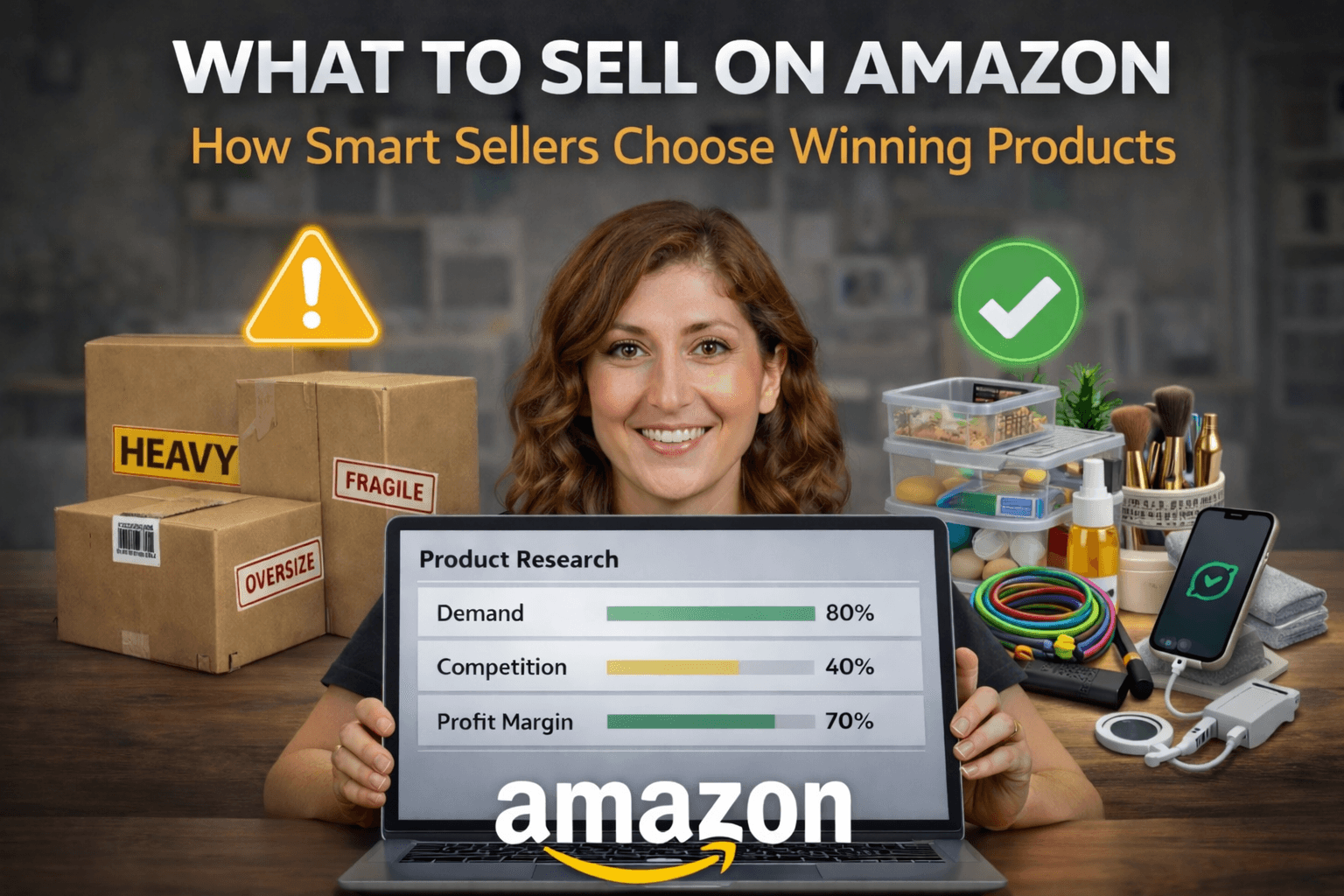
Choosing what to sell on Amazon is the single most important decision you'll make as a seller. Choose the right item, and everything else, from listings to advertising and scaling, becomes much easier to manage. Pick the wrong one, and no amount of marketing will save you.
This guide breaks down the top-performing categories on Amazon, how to evaluate product ideas, and the criteria that separate strong opportunities from costly mistakes. This is where most new sellers either set themselves up for growth or create problems early on, especially if they approach it without the kind of structured framework used inside Amazon Sellers Society.
What Actually Makes an Amazon Product Worth Selling?
Before diving into specific categories, let's establish what you're actually looking for. The products that succeed on Amazon tend to share a few key traits:
Consistent demand: You want something that sells steadily throughout the year, not one that spikes for two weeks and then dies. Seasonal products can work, but they add complexity to inventory planning.
Manageable competition: Avoid products where the first page is dominated by well-known brands with thousands of reviews. Look for niches where the top sellers have decent sales but beatable listings.
Healthy margins: After factoring in product cost, shipping, Amazon fees (referral and FBA), and advertising, you should still have at least 25 to 30 percent net profit. If the numbers don’t make sense upfront, they rarely improve later.
Small and lightweight: Products under 500g and smaller than a shoebox are ideal for FBA. Smaller products mean lower fulfilment fees, lower shipping costs, and more units per shipment.
Not fragile: Breakable products lead to higher return rates, negative reviews, and damaged inventory. Keep it simple.
Low complexity: Avoid products that require extensive instructions, have many variations, or are likely to have quality control issues.
Amazon Categories That Consistently Perform Well
With that foundation in place, here are the categories where sellers consistently find opportunities.
Home & Kitchen
This is one of the largest and most accessible categories. Think kitchen gadgets, organizers, storage solutions, cleaning accessories, and home decor. The demand is broad and consistent, and there are endless niches to explore.
Why this category performs well: Demand stays consistent because people are always looking for practical ways to organize and improve their living spaces. These items are typically lightweight, easy to source, and have strong repeat purchase potential.
Health & Personal Care
Items like vitamins, supplements, skincare tools, grooming accessories, and wellness devices. This category has seen explosive growth, particularly post-pandemic.
What drives demand: Consumers are increasingly health-conscious and willing to spend on self-care products. Many items in this category have strong repeat purchase rates.
Note: Some sub-categories require approval from Amazon and may have additional compliance requirements.
Beauty
Makeup tools, brushes, organizers, skincare accessories, hair care tools, and beauty devices. The beauty market is enormous and continues to grow.
Why sellers focus on this category: Margins are typically strong, and demand is driven by constant product turnover, with customers regularly trying new options. Many beauty accessories are small, lightweight, and relatively easy to source.
Electronics Accessories
Phone cases, screen protectors, charging cables, earphone accessories, laptop stands, and tablet accessories. Not the electronics themselves, but the accessories around them.
What makes this category reliable: Every new phone or tablet release creates a wave of demand for compatible accessories. These items are typically compact, cost-effective to produce, and allow for healthy margins.
Baby Products
Baby-proofing items, feeding accessories, storage solutions, toys, and nursery organizers. Parents are willing to invest in quality products for their children.
Why this category continues to grow: Customers continue buying as their child grows, which increases lifetime value. Purchases are often driven by safety and quality, making buyers less price-sensitive.
Grocery
A growing category, particularly on Amazon.ae. Specialty foods, snacks, health foods, spices, and pantry staples.
What makes this category attractive: Repeat purchases are built in. Once customers find something they like, they often reorder regularly.
Note: Grocery requires category approval and products must comply with food safety regulations.
Sports & Outdoors
Fitness accessories, yoga mats, resistance bands, water bottles, and outdoor gear. Interest in fitness and home workouts continues to drive steady demand in this category.
Why this category continues to perform well: Health and fitness remain a long-term priority for many consumers. Many items are affordable to source and still leave room for strong margins.
How to Tell If a Product Idea Is Worth Pursuing
Once you have shortlisted an idea, run it through this checklist:
Check the demand: Use tools like Helium 10 or Jungle Scout to estimate monthly search volume and sales for similar products. Look for products where the top 10 sellers are each doing at least 100–300 units per month.
Analyze the competition: Look at the top 10 listings on the first page. How many reviews do they have? What's the quality of their listings? Are there obvious gaps you could fill (better images, better bullet points, a feature they're missing)? This is where many new sellers underestimate how competitive a niche really is, particularly when they have not yet understood how product research fits into the wider process of selling on Amazon.
Calculate your margins: Add up all costs including product cost, shipping to Amazon, FBA fees, referral fees, and estimated PPC spend. If you can't hit a 25–30% net margin at a competitive price point, move on. This is another area where many first-time sellers miscalculate and end up with far lower profits than expected.
Check for restrictions: Some categories and products require Amazon's approval. Some products have legal restrictions (e.g., certain supplements, batteries, hazardous materials). Verify before investing.
Assess sourcing difficulty: Can you find a reliable supplier on Alibaba? Are samples readily available? Is the product easy to manufacture consistently? Avoid products that require complex customization for your first launch.
Look for differentiation opportunities: Can you improve on what's already out there? Better packaging, an added feature, higher-quality materials, or a bundle that adds value. You don’t need to reinvent the wheel. In many cases, small improvements are enough to compete effectively.
Product Ideas That Are Worth Testing First
Here are some specific product types that tend to perform well for new sellers:
Kitchen organizers and storage containers
Reusable shopping bags and produce bags
Phone and tablet stands/holders
Cable management solutions
Makeup brush sets and organizers
Essential oil diffuser accessories
Baby feeding bibs and silicone placemats
Resistance bands and exercise accessories
Desk organizers and laptop stands
Pet accessories (bowls, toys, grooming tools)
These are starting points for your research, not guaranteed winners. Each idea should be validated with real data before you commit capital.
Products Beginners Should Avoid (and Why They Fail)
Branded products you don't own: Selling someone else's brand without authorization leads to IP complaints and account suspension.
Products dominated by major brands: Competing against Apple, Samsung, or Nike is a losing battle for a new seller.
Fragile items: High breakage rates mean high return rates, negative reviews, and damaged inventory costs.
Heavy or oversized products: FBA fees for large items can eat your entire margin.
Products with complex compliance requirements: Medical devices, certain electronics, and regulated supplements require certifications that add cost and complexity.
Ultra-cheap products (under AED 30): The margins are too thin after Amazon's fees. You need higher price points to make the numbers work.
Trend-based products: Fidget spinners were great for six months. Don't build a business on a fad.
A Simple Research Process You Can Follow
Browse Amazon's Best Sellers and Movers & Shakers pages for inspiration
Note 10–20 product ideas that interest you
Run each through a product research tool (Helium 10, Jungle Scout)
Narrow to 3–5 products that meet your criteria
Order samples from suppliers for your top picks
Make your final decision based on sample quality, margins, and supplier reliability
Place your first order
If done properly, this process usually takes 2 to 4 weeks. Don't rush it. The time you invest in research pays dividends for the life of your business, which is why more structured approaches like an Amazon accelerator program are designed to guide sellers through this stage more systematically.
Final Thoughts
Most successful sellers do not stumble on a winning idea. They arrive at it through structured research and careful evaluation. It requires consistent research, careful analysis, and proper validation. In practice, many new sellers focus too much on trends and overlook fundamentals. Successful sellers are usually not the ones with the most original idea. They are the ones who methodically evaluate their options and choose the one with the strongest fundamentals.
If you want a structured way to identify profitable products without guessing or wasting time on the wrong ideas, Amazon Sellers Society works with sellers at every stage. From research to launch, the focus is on helping you make decisions backed by data rather than assumptions, so you avoid costly mistakes and unnecessary trial and error.
Frequently Asked Questions
How much money do you need to start selling on Amazon?
Startup costs vary depending on the product, but most sellers begin with a few hundred to a few thousand dollars. This usually covers inventory, shipping, and initial advertising.
How do I know if a product is too competitive?
Look at the first page of results. If most listings have thousands of reviews and strong branding, it may be difficult to compete. Focus on niches where demand exists but listings can still be improved.
Can beginners still succeed on Amazon today?
Yes, but success depends on choosing the right product and executing well. Many new sellers fail because they skip research or rely on trends instead of solid fundamentals.
How long does it take to find a good product?
For most sellers, it takes around 2 to 4 weeks of consistent research. Rushing this step often leads to poor product choices and wasted investment.
What is the biggest mistake new Amazon sellers make?
The most common mistake is choosing a product based on assumptions rather than data. This often leads to poor margins, high competition, or low demand.
Should I focus on trends or evergreen products?
Evergreen products are generally safer because they have consistent demand. Trend-based items can work, but they carry more risk and require precise timing.
Choosing what to sell on Amazon is the single most important decision you'll make as a seller. Choose the right item, and everything else, from listings to advertising and scaling, becomes much easier to manage. Pick the wrong one, and no amount of marketing will save you.
This guide breaks down the top-performing categories on Amazon, how to evaluate product ideas, and the criteria that separate strong opportunities from costly mistakes. This is where most new sellers either set themselves up for growth or create problems early on, especially if they approach it without the kind of structured framework used inside Amazon Sellers Society.
What Actually Makes an Amazon Product Worth Selling?
Before diving into specific categories, let's establish what you're actually looking for. The products that succeed on Amazon tend to share a few key traits:
Consistent demand: You want something that sells steadily throughout the year, not one that spikes for two weeks and then dies. Seasonal products can work, but they add complexity to inventory planning.
Manageable competition: Avoid products where the first page is dominated by well-known brands with thousands of reviews. Look for niches where the top sellers have decent sales but beatable listings.
Healthy margins: After factoring in product cost, shipping, Amazon fees (referral and FBA), and advertising, you should still have at least 25 to 30 percent net profit. If the numbers don’t make sense upfront, they rarely improve later.
Small and lightweight: Products under 500g and smaller than a shoebox are ideal for FBA. Smaller products mean lower fulfilment fees, lower shipping costs, and more units per shipment.
Not fragile: Breakable products lead to higher return rates, negative reviews, and damaged inventory. Keep it simple.
Low complexity: Avoid products that require extensive instructions, have many variations, or are likely to have quality control issues.
Amazon Categories That Consistently Perform Well
With that foundation in place, here are the categories where sellers consistently find opportunities.
Home & Kitchen
This is one of the largest and most accessible categories. Think kitchen gadgets, organizers, storage solutions, cleaning accessories, and home decor. The demand is broad and consistent, and there are endless niches to explore.
Why this category performs well: Demand stays consistent because people are always looking for practical ways to organize and improve their living spaces. These items are typically lightweight, easy to source, and have strong repeat purchase potential.
Health & Personal Care
Items like vitamins, supplements, skincare tools, grooming accessories, and wellness devices. This category has seen explosive growth, particularly post-pandemic.
What drives demand: Consumers are increasingly health-conscious and willing to spend on self-care products. Many items in this category have strong repeat purchase rates.
Note: Some sub-categories require approval from Amazon and may have additional compliance requirements.
Beauty
Makeup tools, brushes, organizers, skincare accessories, hair care tools, and beauty devices. The beauty market is enormous and continues to grow.
Why sellers focus on this category: Margins are typically strong, and demand is driven by constant product turnover, with customers regularly trying new options. Many beauty accessories are small, lightweight, and relatively easy to source.
Electronics Accessories
Phone cases, screen protectors, charging cables, earphone accessories, laptop stands, and tablet accessories. Not the electronics themselves, but the accessories around them.
What makes this category reliable: Every new phone or tablet release creates a wave of demand for compatible accessories. These items are typically compact, cost-effective to produce, and allow for healthy margins.
Baby Products
Baby-proofing items, feeding accessories, storage solutions, toys, and nursery organizers. Parents are willing to invest in quality products for their children.
Why this category continues to grow: Customers continue buying as their child grows, which increases lifetime value. Purchases are often driven by safety and quality, making buyers less price-sensitive.
Grocery
A growing category, particularly on Amazon.ae. Specialty foods, snacks, health foods, spices, and pantry staples.
What makes this category attractive: Repeat purchases are built in. Once customers find something they like, they often reorder regularly.
Note: Grocery requires category approval and products must comply with food safety regulations.
Sports & Outdoors
Fitness accessories, yoga mats, resistance bands, water bottles, and outdoor gear. Interest in fitness and home workouts continues to drive steady demand in this category.
Why this category continues to perform well: Health and fitness remain a long-term priority for many consumers. Many items are affordable to source and still leave room for strong margins.
How to Tell If a Product Idea Is Worth Pursuing
Once you have shortlisted an idea, run it through this checklist:
Check the demand: Use tools like Helium 10 or Jungle Scout to estimate monthly search volume and sales for similar products. Look for products where the top 10 sellers are each doing at least 100–300 units per month.
Analyze the competition: Look at the top 10 listings on the first page. How many reviews do they have? What's the quality of their listings? Are there obvious gaps you could fill (better images, better bullet points, a feature they're missing)? This is where many new sellers underestimate how competitive a niche really is, particularly when they have not yet understood how product research fits into the wider process of selling on Amazon.
Calculate your margins: Add up all costs including product cost, shipping to Amazon, FBA fees, referral fees, and estimated PPC spend. If you can't hit a 25–30% net margin at a competitive price point, move on. This is another area where many first-time sellers miscalculate and end up with far lower profits than expected.
Check for restrictions: Some categories and products require Amazon's approval. Some products have legal restrictions (e.g., certain supplements, batteries, hazardous materials). Verify before investing.
Assess sourcing difficulty: Can you find a reliable supplier on Alibaba? Are samples readily available? Is the product easy to manufacture consistently? Avoid products that require complex customization for your first launch.
Look for differentiation opportunities: Can you improve on what's already out there? Better packaging, an added feature, higher-quality materials, or a bundle that adds value. You don’t need to reinvent the wheel. In many cases, small improvements are enough to compete effectively.
Product Ideas That Are Worth Testing First
Here are some specific product types that tend to perform well for new sellers:
Kitchen organizers and storage containers
Reusable shopping bags and produce bags
Phone and tablet stands/holders
Cable management solutions
Makeup brush sets and organizers
Essential oil diffuser accessories
Baby feeding bibs and silicone placemats
Resistance bands and exercise accessories
Desk organizers and laptop stands
Pet accessories (bowls, toys, grooming tools)
These are starting points for your research, not guaranteed winners. Each idea should be validated with real data before you commit capital.
Products Beginners Should Avoid (and Why They Fail)
Branded products you don't own: Selling someone else's brand without authorization leads to IP complaints and account suspension.
Products dominated by major brands: Competing against Apple, Samsung, or Nike is a losing battle for a new seller.
Fragile items: High breakage rates mean high return rates, negative reviews, and damaged inventory costs.
Heavy or oversized products: FBA fees for large items can eat your entire margin.
Products with complex compliance requirements: Medical devices, certain electronics, and regulated supplements require certifications that add cost and complexity.
Ultra-cheap products (under AED 30): The margins are too thin after Amazon's fees. You need higher price points to make the numbers work.
Trend-based products: Fidget spinners were great for six months. Don't build a business on a fad.
A Simple Research Process You Can Follow
Browse Amazon's Best Sellers and Movers & Shakers pages for inspiration
Note 10–20 product ideas that interest you
Run each through a product research tool (Helium 10, Jungle Scout)
Narrow to 3–5 products that meet your criteria
Order samples from suppliers for your top picks
Make your final decision based on sample quality, margins, and supplier reliability
Place your first order
If done properly, this process usually takes 2 to 4 weeks. Don't rush it. The time you invest in research pays dividends for the life of your business, which is why more structured approaches like an Amazon accelerator program are designed to guide sellers through this stage more systematically.
Final Thoughts
Most successful sellers do not stumble on a winning idea. They arrive at it through structured research and careful evaluation. It requires consistent research, careful analysis, and proper validation. In practice, many new sellers focus too much on trends and overlook fundamentals. Successful sellers are usually not the ones with the most original idea. They are the ones who methodically evaluate their options and choose the one with the strongest fundamentals.
If you want a structured way to identify profitable products without guessing or wasting time on the wrong ideas, Amazon Sellers Society works with sellers at every stage. From research to launch, the focus is on helping you make decisions backed by data rather than assumptions, so you avoid costly mistakes and unnecessary trial and error.
Frequently Asked Questions
How much money do you need to start selling on Amazon?
Startup costs vary depending on the product, but most sellers begin with a few hundred to a few thousand dollars. This usually covers inventory, shipping, and initial advertising.
How do I know if a product is too competitive?
Look at the first page of results. If most listings have thousands of reviews and strong branding, it may be difficult to compete. Focus on niches where demand exists but listings can still be improved.
Can beginners still succeed on Amazon today?
Yes, but success depends on choosing the right product and executing well. Many new sellers fail because they skip research or rely on trends instead of solid fundamentals.
How long does it take to find a good product?
For most sellers, it takes around 2 to 4 weeks of consistent research. Rushing this step often leads to poor product choices and wasted investment.
What is the biggest mistake new Amazon sellers make?
The most common mistake is choosing a product based on assumptions rather than data. This often leads to poor margins, high competition, or low demand.
Should I focus on trends or evergreen products?
Evergreen products are generally safer because they have consistent demand. Trend-based items can work, but they carry more risk and require precise timing.
Ready to grow your Amazon business with Expert Guidance?
Join 1000+ growing network of Amazon entrepreneurs building real, profitable brands.
THINK
BIG!
SELL
BIGGER!!





sellerssociety©️2026
All Rights Reserved
Ready to grow your Amazon business with Expert Guidance?
Join 1000+ growing network of Amazon entrepreneurs building real, profitable brands.
THINK
BIG!
SELL
BIGGER!!
sellerssociety©️2026
All Rights Reserved
Ready to grow your Amazon business with Expert Guidance?
Join 1000+ growing network of Amazon entrepreneurs building real, profitable brands.
THINK
BIG!
SELL
BIGGER!!
sellerssociety©️2026
All Rights Reserved