
Basics
Amazon Review Strategy for UAE & KSA Sellers: How to Build Social Proof That Converts
Amazon Review Strategy for UAE & KSA Sellers: How to Build Social Proof That Converts
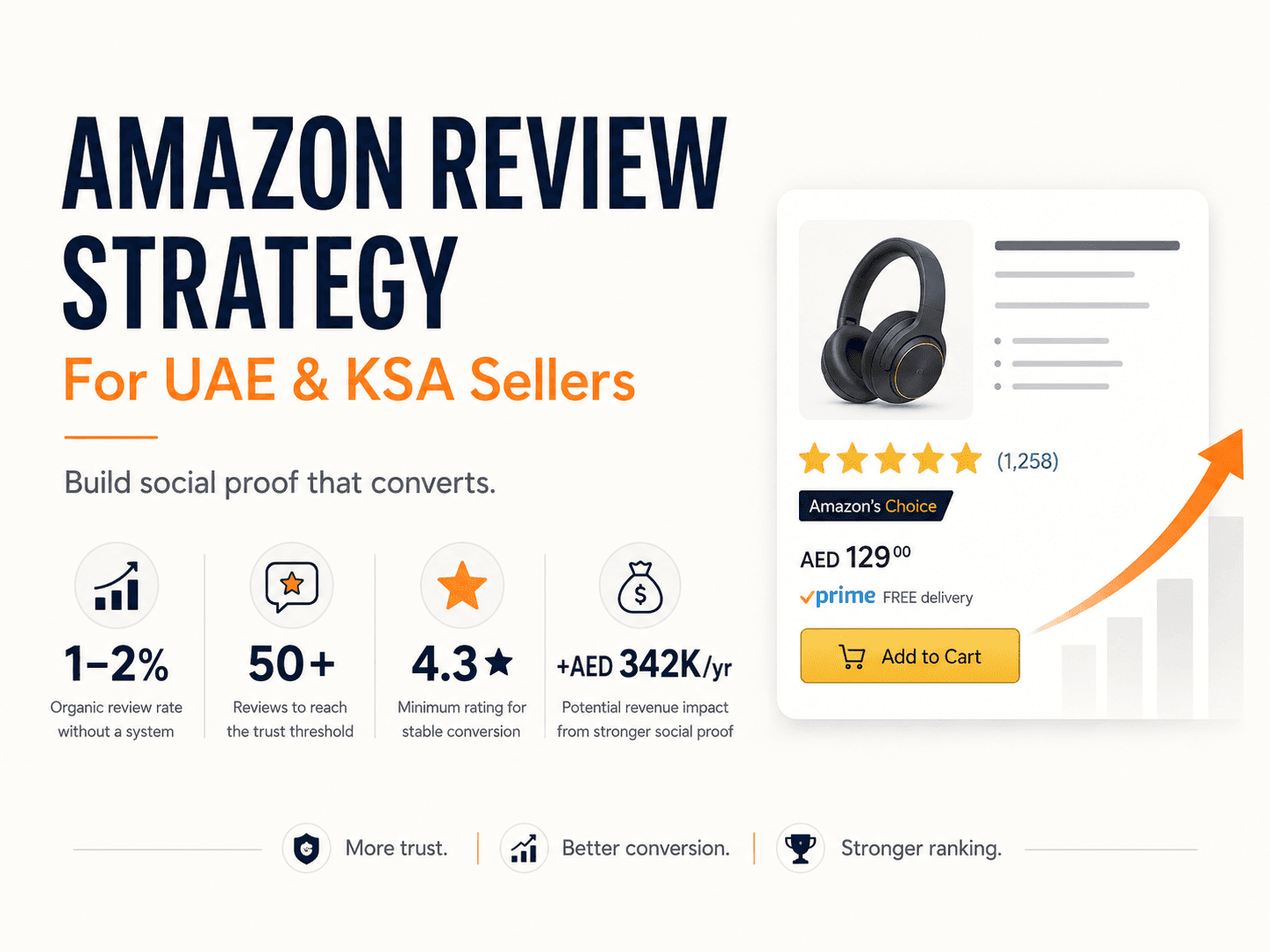
Reviews are the single most powerful conversion driver on Amazon — more than your images, more than your copy, more than your price. A product with 200 reviews at 4.5 stars will outsell a better product with 12 reviews at 4.8 stars in the same category almost every time. Not because buyers are irrational — but because social proof is how trust is transferred at scale on a platform where shoppers cannot physically see or test your product.
On Amazon.ae and Amazon.sa specifically, this dynamic is even more pronounced. Both platforms are relatively young, and buyer confidence in new sellers is still building. Reviews are the fastest way to close that trust gap and establish credibility in the Middle East market.
This is the complete review strategy for sellers on Amazon.ae and Amazon.sa — how to generate reviews at velocity using compliant methods, what types convert best, how to protect your rating, and how to turn social proof into a competitive moat.
Stat | What It Means |
|---|---|
1–2% | Organic review rate without a system |
50+ | Reviews needed to hit the trust threshold |
+AED 342,000/yr | Revenue impact of going from 10 to 200 reviews on an AED 165 product |
4.3★ | Minimum rating for conversion rate stability |
The Revenue Math: Why Reviews Are Your Highest-ROI Investment
Most sellers allocate budget across PPC, photography, and inventory without ever calculating the ROI of review investment. When you run the numbers, review strategy consistently outperforms every other allocation.
At 10 reviews — where most sellers get stuck:
Monthly sessions: 2,000
Conversion rate: 5–7%
Monthly orders: 100–140
Monthly revenue (at AED 165 AOV): AED 16,500–AED 23,000
Annual revenue: ~AED 231,000
At 200 reviews — what a system builds in 90 days:
Monthly sessions: 2,000
Conversion rate: 13–16%
Monthly orders: 260–320
Monthly revenue: AED 43,000–AED 53,000
Annual revenue: ~AED 573,000 (+AED 342,000)
That AED 342,000 annual difference comes from the same traffic, same product, same price, and same ad spend. The only variable is reviews. There is no marketing investment in this business with a comparable return.
Reviews also compound through your PPC efficiency. Higher CVR means better organic rank. Better organic rank means cheaper clicks. Cheaper clicks lower your ACoS. Lower ACoS lets you bid more aggressively. More sessions at a higher CVR generates more reviews. The flywheel spins faster with every review milestone you cross.
The Trust Threshold: What the Data Actually Says
Not all review milestones are equal. Conversion rate data reveals specific thresholds where buyer behaviour changes meaningfully:
Stage | Review Count | What It Means |
|---|---|---|
🔴 Critical gap | 0–9 reviews | CVR severely suppressed. Do not scale PPC here. |
🟠 Below threshold | 10–24 reviews | Amazon's own recommended minimum to begin PPC testing. Not for scaling. |
🟡 Approaching trust | 25–49 reviews | CVR improving. Begin scaling PPC cautiously while continuing to build. |
🟢 Trust threshold | 50+ reviews | CVR stabilises at or above category average. Scale PPC aggressively from here. |
⚠️ The 4.3-star floor is non-negotiable. Below 4.3 stars, conversion rate drops significantly regardless of review count. A product with 500 reviews at 3.9 stars will convert worse than one with 80 reviews at 4.6 stars. Before investing in review velocity, ensure your product quality, packaging, and listing accuracy are strong enough to sustain a 4.3+ average. Reviews are a mirror of your product — no strategy in this guide can make a genuinely bad product succeed long-term.
Strategy 1: Your Network — The First Reviews on Amazon.ae and Amazon.sa
Amazon Vine — the programme used on Amazon.com to seed initial reviews from verified reviewers — is not available on Amazon.ae or Amazon.sa. This means Middle East sellers need to build their first review foundation differently, and the most effective starting point is the network you already have.
Here is how to do it correctly and compliantly.
The approach: When you launch a new product, announce it to your existing network and ask them to purchase it on Amazon.ae or Amazon.sa at the full listing price, use it genuinely, and then leave an honest review. The key word is purchase — reviews from verified purchases carry full weight on Amazon, establish your sales velocity, and are completely compliant. Gifting products for reviews without a purchase is against Amazon's Terms of Service and carries account suspension risk.
Who to reach:
Past customers — if you have sold other products on Amazon.ae or Amazon.sa, message your previous buyers through compliant channels. Let them know you have launched something new, invite them to check it out, and if they purchase, follow up with a review request through Amazon's built-in tool.
Friends and family — ask them to purchase the product at full price on Amazon.ae or Amazon.sa, use it genuinely, and share their honest experience. Be clear: you want an authentic review, not a favour. An honest 4-star review with genuine written content is worth far more than a hollow 5-star review with no detail.
Social media followers — announce the product launch across your Instagram, TikTok, LinkedIn, or WhatsApp community. Tell them the product is now live on Amazon.ae and Amazon.sa, share the link, and let them know you would appreciate their honest feedback after purchasing. On platforms where it's culturally natural — WhatsApp broadcast lists are particularly effective in the Middle East — a personal announcement with a direct link drives immediate action.
What to say: Keep it genuine and low-pressure. "Our new [product] is now live on Amazon.ae — we would love for you to try it and share your honest thoughts as a review. Your feedback genuinely helps us improve and helps other shoppers decide." Do not ask specifically for 5 stars. Do not offer discounts, cash, or gifts in exchange for reviews. The purchase itself is what makes the review legitimate.
What to realistically expect: This first wave of network reviews will typically yield 10–25 reviews depending on the size and engagement of your network. They will not all be 5 stars — and that is fine. A mix of honest 4 and 5-star reviews with real written content is more credible to both shoppers and Amazon's algorithm than a stack of identical 5-star reviews. This gets you to the initial threshold Amazon requires before other strategies begin to compound.
Timing: Do this on or immediately after launch day. The first 30 days of a listing's life are critical for establishing sales velocity and initial ranking signals. Your network launch should run simultaneously with insert cards and the Request a Review automation from day one — not as a later add-on.
Strategy 2: Request a Review — Your Highest-Volume Consistent Tool
The Manual Request a Review button inside Seller Central is Amazon's built-in review request tool. It sends an Amazon-formatted, non-customisable email to the buyer asking for a product review and seller feedback. It generates reviews on approximately 1–3% of orders — meaning for a seller doing 1,000 orders per month, that is 10–30 new reviews monthly with zero additional cost.
The problem: clicking this button manually for every order is unsustainable at scale. The solution is automation.
Manual method (under 200 orders/month): Go to Seller Central → Orders → Manage Orders → select each eligible order → click "Request a Review." Orders are eligible between 5 and 30 days after delivery. Do this daily during the eligible window.
Automated tools (200+ orders/month): Tools like Helium 10 Follow-Up and Jungle Scout Review Automation trigger the Request a Review for every eligible order automatically. Set it once and it runs permanently across all ASINs. Cost: AED 110–370/month depending on tool and order volume. ROI is immediate at scale.
Timing: The optimal window is 7–14 days after confirmed delivery — early enough that the product experience is fresh, late enough for the buyer to have actually used it. For consumable products, request slightly earlier (day 6–7) while the experience is most vivid.
The compliance line: Amazon's Request a Review button sends a standardised message you cannot customise. You cannot add "only if you had a positive experience" language — this is review manipulation and a suspension risk. You cannot offer incentives. You cannot follow up more than once per order.
Strategy 3: Insert Cards — Your Passive Always-On Review Engine
A well-designed insert card in every FBA package is one of the most scalable review generation tools because it works passively on every order without any ongoing effort. Once the card is in production, every package becomes a review request — compounding across thousands of monthly orders indefinitely.
What you can do (compliant):
Ask for an honest review: "We would love to hear your thoughts. Share your experience on Amazon."
Include a QR code linking to your listing's review page
Include genuinely helpful product usage tips
Provide customer service contact details: "Any issue at all, email us first and we make it right"
Show your brand story or social media handles
What will get your account suspended:
Cherry-picking: "If you love it, please leave a review. If not, contact us first"
Incentivised reviews: "Leave a 5-star review and get a discount"
Any language that conditions the review request on a positive experience
Requesting reviews more than once per order through any channel
Well-designed insert cards increase review rates by 0.5–1.5 percentage points above baseline. On 2,000 monthly orders, that is an additional 10–30 reviews per month from packaging alone — at a production cost of AED 0.35–0.55 per card after initial design.
Middle East note: Consider printing insert cards in both English and Arabic. A bilingual card immediately signals to Middle East shoppers that this brand was built for them, not adapted from a foreign market — and it meaningfully increases the likelihood of engagement from Arabic-speaking buyers.
Strategy 4: ManyChat — Your High-Response Direct Channel
ManyChat is a Facebook and Instagram messaging automation tool that lets you build a subscriber list of customers who have opted in to receive messages from your brand. A ManyChat broadcast to your customer list requesting Amazon reviews consistently achieves response rates of 15–30% — dramatically higher than email or the standard Request a Review button — because it reaches buyers through a personal messaging channel they actually check.
The strategy runs in three phases. First, build a ManyChat subscriber list through your social media content, giveaways, or lead magnets. Second, when someone purchases your Amazon product (captured through an insert card QR code or a promotional flow), they enter a "customer" segment in your ManyChat account. Third, 7–14 days after estimated delivery, broadcast a warm, personal-feeling message to that segment asking for an honest Amazon review.
Sample message: "Hey [name] — if you have had a chance to try your [product], we would love your honest feedback on Amazon. Here is the direct review link: [link]. Thank you!"
Middle East note: WhatsApp is the dominant messaging platform in the UAE and KSA — far more so than Facebook Messenger or Instagram DM. If you have a customer WhatsApp list or a WhatsApp Business account with engaged followers, a WhatsApp broadcast asking for reviews after purchase is one of the highest-response channels available to Middle East sellers. Keep it personal, genuine, and pressure-free.
Strategy 5: The Top Reviews Section — Your Most Visible Social Proof
The Top Reviews section is the most viewed part of your review content — it is what appears before shoppers click "see all reviews." Most sellers completely ignore its composition. Top sellers manage it actively.
Amazon surfaces reviews in Top Reviews based on "helpfulness" votes — any customer can upvote reviews they find helpful. This is publicly available, completely compliant, and almost nobody does it systematically.
Upvote your best reviews using the "Helpful" button. Find your most detailed, genuinely positive reviews and click "Helpful." Have your team, friends, and family do the same from their own Amazon accounts. A review with 8–10 helpful votes will surface above one with zero votes, regardless of star rating.
Target the visible 8-review window. On desktop, approximately 8 reviews are visible before "see more reviews." On mobile, even fewer. Every 4 or 5-star review you surface into that visible window is a conversion-positive impression. Every 1 or 2-star review appearing there is actively destroying sales.
Respond professionally to every negative review. Your response appears directly beneath the review and is visible to all shoppers. A calm, professional response — "We are sorry to hear about your experience — please contact us at [email] so we can make this right" — signals to future buyers that you stand behind your product. It often prompts the original reviewer to update their review after their issue is resolved.
Report removable negative reviews within 90 days. Reviews containing profanity, personal attacks, irrelevant content, competitor promotion, or factually false claims can be reported for removal via Seller Central → Community Guidelines violation. Amazon removes approximately 30–40% of legitimately reported reviews. Be specific about which guideline is violated.
Strategy 6: Amazon's AI — What It Does With Your Reviews
Amazon's AI shopping assistant influences product discovery for hundreds of millions of shoppers — and it reads your reviews as part of how it makes recommendations. Shoppers who interact with it convert at 60% higher rates than standard search shoppers. This makes your review content — not just your review count — an increasingly important optimisation variable.
Thematic pattern recognition: The AI identifies recurring themes across all your reviews and surfaces them as "Customers say" snippets on your listing. If 40 reviews mention "lasts all day," that phrase appears prominently in AI-generated summaries. The more reviews that use consistent language about your key benefit, the more that benefit gets surfaced to shoppers.
Q&A and review cross-reference: When a shopper asks the AI a question about your product, it pulls answers from both your Q&A section and your review content. Detailed reviews that answer common buyer questions serve double duty as both social proof and AI-discoverable content.
Negative pattern amplification: The AI also surfaces recurring negative themes. If 15 reviews mention "smaller than expected," that will be flagged in recommendation context. This is why addressing the root cause of recurring negative reviews is an AI optimisation strategy, not just customer service.
The practical implication: Encourage buyers to describe their specific experience with the product's primary benefit — not just "great product, very happy." Your insert card and WhatsApp/ManyChat language should prompt specific feedback: "Tell us how [product] fits into your routine" rather than just "share your experience."
The Launch Sequence: Getting to 50 Reviews in 60 Days
The window between zero and 50 reviews is the most dangerous period in any Amazon product's life. Most products that fail on Amazon.ae and Amazon.sa do not fail because of bad products — they fail because they never crossed the trust threshold before running out of launch budget. Here is the sequence:
Day 1 — Launch Day: Activate Your Network The moment your listing goes live, announce it to your full network — past customers, friends, family, social media followers, and WhatsApp contacts. Ask them to purchase the product at full price on Amazon.ae or Amazon.sa and share their honest experience as a review. Simultaneously, ensure your Request a Review automation tool is live and configured to trigger at day 8–10 post-delivery for all orders. Insert cards should be in all FBA packaging from day one.
Week 2 — Build Sales Velocity Launch PPC campaigns at competitive bids to generate session velocity. Every sale is a potential review request. Continue following up with your network via WhatsApp or DM for those who haven't purchased yet. Your first organic reviews from the network launch begin to arrive this week.
Week 4 — First Reviews Live, Manage Actively You should now have 10–20 reviews from your network launch and early organic orders. Review each one carefully. If consistent issues appear (sizing, packaging, inaccurate listing images), fix the root cause immediately. Upvote your best reviews using the Helpful button to push them into the visible Top Reviews window. Respond professionally to any negative reviews.
Week 6 — Approaching the Trust Threshold With network reviews plus ongoing Request a Review automation and insert cards, you should be approaching 25–35 reviews. Begin scaling PPC more aggressively — conversion rate is improving with each review milestone. Continue all strategies simultaneously.
Day 60 — Trust Threshold: Scale Everything At 50+ reviews and 4.3+ stars, your listing has crossed the trust threshold. CVR stabilises at or above category average. PPC compounds more efficiently. Organic rank is building from improved conversion signals. Continue all review generation strategies indefinitely — the goal is 100, then 250, then 500+ over the next 6–12 months. Review velocity is a moat that takes competitors years to overcome.
Protecting Your Star Rating Long-Term
Building reviews is only half the strategy. Maintaining your star rating above 4.3 stars as you scale is equally critical.
Weekly rating monitoring: Check your overall star rating and recent reviews weekly. A single viral negative review can tank your rating before you realise it is happening. Set up Seller Central alerts or use Helium 10 Review Insights to get notified when new reviews post.
Listing accuracy audits: The most common negative review trigger is "not as described." Quarterly, review your images and bullets against your actual product. Size references, dimensions, material descriptions, and what's-in-box claims must be 100% accurate.
Packaging quality control: FBA warehouse handling is rougher than you expect. Products arriving damaged generate 1-star reviews instantly. Over-engineer your inner packaging — a small investment in protective materials protects a significant annual revenue stream.
Customer service response speed: Respond to buyer messages within 24 hours, every day including weekends. Buyers who receive fast, generous customer service rarely post negative reviews. Offer full refunds or free replacements without requiring returns for lower-value orders — the review protection value far exceeds the cost.
Removable review reporting: Report reviews that violate Community Guidelines within 90 days. Reviewable violations include profanity, personal attacks, off-topic content, competitor promotion, and false factual claims. Amazon removes 30–40% of properly reported reviews.
Recurring complaint response: If 5+ reviews mention the same issue, fix the product or listing — not the reviews. The pattern will continue regardless of how many individual reviews you manage. Root cause resolution is the only permanent fix.
Reading Your Review Data as Business Intelligence
Your reviews contain more actionable product and listing optimisation data than most sellers ever extract.
Search for recurring specific words in your 1–3 star reviews. Use Ctrl+F on your reviews page and search for terms like "small," "broke," "smell," "wrong." Patterns appearing 3+ times represent fixable issues costing you both revenue and rating points.
Mine 5-star review language for listing copy. The exact words your happiest customers use to describe your product's benefits are your highest-converting listing copy. If reviewers keep saying "it actually works for my skin type" and your bullets say "gentle formula" — your bullets should say "actually works for your skin type." Customer language beats marketing language every time.
Track the "Customers say" feature on your listing. This AI-generated summary is a direct window into how Amazon's algorithm is interpreting your review content. If it is highlighting a negative pattern, fix it at the product or listing level. If it is surfacing your key benefit accurately, your review strategy is working.
Compare your review themes against competitor reviews. Where competitors have consistent negative themes, your listing can explicitly address that gap: "Unlike other [category] products that [common complaint], our [feature] means [benefit]." Competitor weaknesses become your conversion copy.
The Most Common Review Strategy Mistakes on Amazon.ae and Amazon.sa
Waiting until after launch to think about reviews. The sellers who reach 50 reviews fastest have their network launch announcement ready, their insert cards in packaging, and their Request a Review automation live before the first order ships. Reviews require a 60–90 day lead time even with the best strategy — start everything on day one.
Cherry-picking review requests. Any language that conditions the ask on a positive experience is review manipulation. "If you are happy with your purchase, we would appreciate a review" is a violation. "We would love your honest feedback" is compliant. The distinction seems minor but the difference is account suspension vs a sustainable strategy.
Asking for reviews without a purchase. Sending free products to friends or influencers and asking them to leave an Amazon review without purchasing first violates Amazon's TOS. The purchase is what makes the review legitimate. Always ask your network to buy first, then review.
Ignoring the Top Reviews section. Your top 8 visible reviews are doing more conversion work than reviews 50–200 combined. If a 2-star review is appearing in that visible window, it is actively destroying sales every day it sits there. Manage the Helpful votes on your best reviews proactively.
Not responding to negative reviews. Every negative review without a response is an unanswered objection in front of every future shopper who reads it. A professional response takes 3 minutes and can turn a damaging review into a demonstration of excellent customer service.
Treating review generation as a launch activity. A product generating 30 new reviews per month for 12 months ends the year with 360 reviews. A product that ran a launch effort and stopped ends the year with 45 reviews. The gap is entirely determined by consistency. Run your systems every month, not just at launch.
Not using review data to improve the listing. Sellers who ignore the signals in their 1–3 star reviews keep generating the same negative reviews about the same fixable issues indefinitely. The highest-performing sellers treat every cluster of negative reviews as a product development and listing optimisation brief.
Frequently Asked Questions
How long does it take to get reviews on Amazon.ae and Amazon.sa? With a full system running from day one — network launch announcement, Request a Review automation, and insert cards — most products reach 25–30 reviews within 30–45 days and 50+ reviews within 60–90 days. Without a system, reaching 50 reviews organically at a 1–2% review rate requires 2,500–5,000 orders, which can take 6–12 months or more. The difference is entirely the presence or absence of a systematic approach from launch.
Can I ask friends and family to leave reviews? Yes — as long as they genuinely purchase the product at full price on Amazon, use it, and leave an honest review based on their real experience. What you cannot do is give them the product for free in exchange for a review, ask them to leave only positive reviews, or compensate them in any way for the review. The purchase is what makes the review verified and compliant.
How do I get a negative review removed from Amazon? Amazon removes reviews that violate Community Guidelines — profanity, personal attacks, content unrelated to the product, competitor promotion, or false factual claims. Report via Seller Central → Community Guidelines violation within 90 days, and be specific about which guideline is violated. Amazon removes approximately 30–40% of legitimately reported reviews. Honest unfavourable opinions about a genuine experience cannot be removed — address the root cause instead.
What is the minimum star rating I need to maintain? 4.3 stars is the floor where conversion rates stabilise at or above category average. Below 4.3, CVR drops significantly regardless of review count. If your rating falls below 4.3, pause PPC scaling, identify and fix the root cause of negative reviews, and generate enough new positive reviews to bring the average back up before scaling again.
How does Amazon's AI use my reviews? Amazon's AI reads your full review content to generate product recommendations and the "Customers say" summaries that appear on your listing. It identifies recurring themes and surfaces them to shoppers — both positive patterns and negative ones. Reviews that use specific, descriptive language about the product experience contribute more than generic star-and-sentence reviews. This makes review quality — not just quantity — an increasingly important variable.
How do reviews connect to my listing optimisation strategy? Reviews and listing optimisation form a compounding system. Better listings generate higher CVR, which drives more sales, which generates more reviews. More reviews improve CVR further, which lowers PPC costs and improves organic rank. The reviews themselves contain the best copy for improving your bullets and A+ content — buyer language in 5-star reviews is more persuasive than anything written without that real-world input. Run both in parallel.
Ready to Build Your Review Foundation?
Most sellers on Amazon.ae and Amazon.sa are leaving reviews — and the revenue that comes with them — on the table because they have no system. The gap between a listing with 8 reviews and one with 150 is not product quality. It is process.
Sellers Society works with Middle East-based sellers on Amazon.ae, Amazon.sa, and other marketplaces to build the listing, the launch strategy, and the review systems that turn traffic into compounding revenue.
Book A Free Call
Sellers Society | Amazon & Marketplace Seller Agency
Reviews are the single most powerful conversion driver on Amazon — more than your images, more than your copy, more than your price. A product with 200 reviews at 4.5 stars will outsell a better product with 12 reviews at 4.8 stars in the same category almost every time. Not because buyers are irrational — but because social proof is how trust is transferred at scale on a platform where shoppers cannot physically see or test your product.
On Amazon.ae and Amazon.sa specifically, this dynamic is even more pronounced. Both platforms are relatively young, and buyer confidence in new sellers is still building. Reviews are the fastest way to close that trust gap and establish credibility in the Middle East market.
This is the complete review strategy for sellers on Amazon.ae and Amazon.sa — how to generate reviews at velocity using compliant methods, what types convert best, how to protect your rating, and how to turn social proof into a competitive moat.
Stat | What It Means |
|---|---|
1–2% | Organic review rate without a system |
50+ | Reviews needed to hit the trust threshold |
+AED 342,000/yr | Revenue impact of going from 10 to 200 reviews on an AED 165 product |
4.3★ | Minimum rating for conversion rate stability |
The Revenue Math: Why Reviews Are Your Highest-ROI Investment
Most sellers allocate budget across PPC, photography, and inventory without ever calculating the ROI of review investment. When you run the numbers, review strategy consistently outperforms every other allocation.
At 10 reviews — where most sellers get stuck:
Monthly sessions: 2,000
Conversion rate: 5–7%
Monthly orders: 100–140
Monthly revenue (at AED 165 AOV): AED 16,500–AED 23,000
Annual revenue: ~AED 231,000
At 200 reviews — what a system builds in 90 days:
Monthly sessions: 2,000
Conversion rate: 13–16%
Monthly orders: 260–320
Monthly revenue: AED 43,000–AED 53,000
Annual revenue: ~AED 573,000 (+AED 342,000)
That AED 342,000 annual difference comes from the same traffic, same product, same price, and same ad spend. The only variable is reviews. There is no marketing investment in this business with a comparable return.
Reviews also compound through your PPC efficiency. Higher CVR means better organic rank. Better organic rank means cheaper clicks. Cheaper clicks lower your ACoS. Lower ACoS lets you bid more aggressively. More sessions at a higher CVR generates more reviews. The flywheel spins faster with every review milestone you cross.
The Trust Threshold: What the Data Actually Says
Not all review milestones are equal. Conversion rate data reveals specific thresholds where buyer behaviour changes meaningfully:
Stage | Review Count | What It Means |
|---|---|---|
🔴 Critical gap | 0–9 reviews | CVR severely suppressed. Do not scale PPC here. |
🟠 Below threshold | 10–24 reviews | Amazon's own recommended minimum to begin PPC testing. Not for scaling. |
🟡 Approaching trust | 25–49 reviews | CVR improving. Begin scaling PPC cautiously while continuing to build. |
🟢 Trust threshold | 50+ reviews | CVR stabilises at or above category average. Scale PPC aggressively from here. |
⚠️ The 4.3-star floor is non-negotiable. Below 4.3 stars, conversion rate drops significantly regardless of review count. A product with 500 reviews at 3.9 stars will convert worse than one with 80 reviews at 4.6 stars. Before investing in review velocity, ensure your product quality, packaging, and listing accuracy are strong enough to sustain a 4.3+ average. Reviews are a mirror of your product — no strategy in this guide can make a genuinely bad product succeed long-term.
Strategy 1: Your Network — The First Reviews on Amazon.ae and Amazon.sa
Amazon Vine — the programme used on Amazon.com to seed initial reviews from verified reviewers — is not available on Amazon.ae or Amazon.sa. This means Middle East sellers need to build their first review foundation differently, and the most effective starting point is the network you already have.
Here is how to do it correctly and compliantly.
The approach: When you launch a new product, announce it to your existing network and ask them to purchase it on Amazon.ae or Amazon.sa at the full listing price, use it genuinely, and then leave an honest review. The key word is purchase — reviews from verified purchases carry full weight on Amazon, establish your sales velocity, and are completely compliant. Gifting products for reviews without a purchase is against Amazon's Terms of Service and carries account suspension risk.
Who to reach:
Past customers — if you have sold other products on Amazon.ae or Amazon.sa, message your previous buyers through compliant channels. Let them know you have launched something new, invite them to check it out, and if they purchase, follow up with a review request through Amazon's built-in tool.
Friends and family — ask them to purchase the product at full price on Amazon.ae or Amazon.sa, use it genuinely, and share their honest experience. Be clear: you want an authentic review, not a favour. An honest 4-star review with genuine written content is worth far more than a hollow 5-star review with no detail.
Social media followers — announce the product launch across your Instagram, TikTok, LinkedIn, or WhatsApp community. Tell them the product is now live on Amazon.ae and Amazon.sa, share the link, and let them know you would appreciate their honest feedback after purchasing. On platforms where it's culturally natural — WhatsApp broadcast lists are particularly effective in the Middle East — a personal announcement with a direct link drives immediate action.
What to say: Keep it genuine and low-pressure. "Our new [product] is now live on Amazon.ae — we would love for you to try it and share your honest thoughts as a review. Your feedback genuinely helps us improve and helps other shoppers decide." Do not ask specifically for 5 stars. Do not offer discounts, cash, or gifts in exchange for reviews. The purchase itself is what makes the review legitimate.
What to realistically expect: This first wave of network reviews will typically yield 10–25 reviews depending on the size and engagement of your network. They will not all be 5 stars — and that is fine. A mix of honest 4 and 5-star reviews with real written content is more credible to both shoppers and Amazon's algorithm than a stack of identical 5-star reviews. This gets you to the initial threshold Amazon requires before other strategies begin to compound.
Timing: Do this on or immediately after launch day. The first 30 days of a listing's life are critical for establishing sales velocity and initial ranking signals. Your network launch should run simultaneously with insert cards and the Request a Review automation from day one — not as a later add-on.
Strategy 2: Request a Review — Your Highest-Volume Consistent Tool
The Manual Request a Review button inside Seller Central is Amazon's built-in review request tool. It sends an Amazon-formatted, non-customisable email to the buyer asking for a product review and seller feedback. It generates reviews on approximately 1–3% of orders — meaning for a seller doing 1,000 orders per month, that is 10–30 new reviews monthly with zero additional cost.
The problem: clicking this button manually for every order is unsustainable at scale. The solution is automation.
Manual method (under 200 orders/month): Go to Seller Central → Orders → Manage Orders → select each eligible order → click "Request a Review." Orders are eligible between 5 and 30 days after delivery. Do this daily during the eligible window.
Automated tools (200+ orders/month): Tools like Helium 10 Follow-Up and Jungle Scout Review Automation trigger the Request a Review for every eligible order automatically. Set it once and it runs permanently across all ASINs. Cost: AED 110–370/month depending on tool and order volume. ROI is immediate at scale.
Timing: The optimal window is 7–14 days after confirmed delivery — early enough that the product experience is fresh, late enough for the buyer to have actually used it. For consumable products, request slightly earlier (day 6–7) while the experience is most vivid.
The compliance line: Amazon's Request a Review button sends a standardised message you cannot customise. You cannot add "only if you had a positive experience" language — this is review manipulation and a suspension risk. You cannot offer incentives. You cannot follow up more than once per order.
Strategy 3: Insert Cards — Your Passive Always-On Review Engine
A well-designed insert card in every FBA package is one of the most scalable review generation tools because it works passively on every order without any ongoing effort. Once the card is in production, every package becomes a review request — compounding across thousands of monthly orders indefinitely.
What you can do (compliant):
Ask for an honest review: "We would love to hear your thoughts. Share your experience on Amazon."
Include a QR code linking to your listing's review page
Include genuinely helpful product usage tips
Provide customer service contact details: "Any issue at all, email us first and we make it right"
Show your brand story or social media handles
What will get your account suspended:
Cherry-picking: "If you love it, please leave a review. If not, contact us first"
Incentivised reviews: "Leave a 5-star review and get a discount"
Any language that conditions the review request on a positive experience
Requesting reviews more than once per order through any channel
Well-designed insert cards increase review rates by 0.5–1.5 percentage points above baseline. On 2,000 monthly orders, that is an additional 10–30 reviews per month from packaging alone — at a production cost of AED 0.35–0.55 per card after initial design.
Middle East note: Consider printing insert cards in both English and Arabic. A bilingual card immediately signals to Middle East shoppers that this brand was built for them, not adapted from a foreign market — and it meaningfully increases the likelihood of engagement from Arabic-speaking buyers.
Strategy 4: ManyChat — Your High-Response Direct Channel
ManyChat is a Facebook and Instagram messaging automation tool that lets you build a subscriber list of customers who have opted in to receive messages from your brand. A ManyChat broadcast to your customer list requesting Amazon reviews consistently achieves response rates of 15–30% — dramatically higher than email or the standard Request a Review button — because it reaches buyers through a personal messaging channel they actually check.
The strategy runs in three phases. First, build a ManyChat subscriber list through your social media content, giveaways, or lead magnets. Second, when someone purchases your Amazon product (captured through an insert card QR code or a promotional flow), they enter a "customer" segment in your ManyChat account. Third, 7–14 days after estimated delivery, broadcast a warm, personal-feeling message to that segment asking for an honest Amazon review.
Sample message: "Hey [name] — if you have had a chance to try your [product], we would love your honest feedback on Amazon. Here is the direct review link: [link]. Thank you!"
Middle East note: WhatsApp is the dominant messaging platform in the UAE and KSA — far more so than Facebook Messenger or Instagram DM. If you have a customer WhatsApp list or a WhatsApp Business account with engaged followers, a WhatsApp broadcast asking for reviews after purchase is one of the highest-response channels available to Middle East sellers. Keep it personal, genuine, and pressure-free.
Strategy 5: The Top Reviews Section — Your Most Visible Social Proof
The Top Reviews section is the most viewed part of your review content — it is what appears before shoppers click "see all reviews." Most sellers completely ignore its composition. Top sellers manage it actively.
Amazon surfaces reviews in Top Reviews based on "helpfulness" votes — any customer can upvote reviews they find helpful. This is publicly available, completely compliant, and almost nobody does it systematically.
Upvote your best reviews using the "Helpful" button. Find your most detailed, genuinely positive reviews and click "Helpful." Have your team, friends, and family do the same from their own Amazon accounts. A review with 8–10 helpful votes will surface above one with zero votes, regardless of star rating.
Target the visible 8-review window. On desktop, approximately 8 reviews are visible before "see more reviews." On mobile, even fewer. Every 4 or 5-star review you surface into that visible window is a conversion-positive impression. Every 1 or 2-star review appearing there is actively destroying sales.
Respond professionally to every negative review. Your response appears directly beneath the review and is visible to all shoppers. A calm, professional response — "We are sorry to hear about your experience — please contact us at [email] so we can make this right" — signals to future buyers that you stand behind your product. It often prompts the original reviewer to update their review after their issue is resolved.
Report removable negative reviews within 90 days. Reviews containing profanity, personal attacks, irrelevant content, competitor promotion, or factually false claims can be reported for removal via Seller Central → Community Guidelines violation. Amazon removes approximately 30–40% of legitimately reported reviews. Be specific about which guideline is violated.
Strategy 6: Amazon's AI — What It Does With Your Reviews
Amazon's AI shopping assistant influences product discovery for hundreds of millions of shoppers — and it reads your reviews as part of how it makes recommendations. Shoppers who interact with it convert at 60% higher rates than standard search shoppers. This makes your review content — not just your review count — an increasingly important optimisation variable.
Thematic pattern recognition: The AI identifies recurring themes across all your reviews and surfaces them as "Customers say" snippets on your listing. If 40 reviews mention "lasts all day," that phrase appears prominently in AI-generated summaries. The more reviews that use consistent language about your key benefit, the more that benefit gets surfaced to shoppers.
Q&A and review cross-reference: When a shopper asks the AI a question about your product, it pulls answers from both your Q&A section and your review content. Detailed reviews that answer common buyer questions serve double duty as both social proof and AI-discoverable content.
Negative pattern amplification: The AI also surfaces recurring negative themes. If 15 reviews mention "smaller than expected," that will be flagged in recommendation context. This is why addressing the root cause of recurring negative reviews is an AI optimisation strategy, not just customer service.
The practical implication: Encourage buyers to describe their specific experience with the product's primary benefit — not just "great product, very happy." Your insert card and WhatsApp/ManyChat language should prompt specific feedback: "Tell us how [product] fits into your routine" rather than just "share your experience."
The Launch Sequence: Getting to 50 Reviews in 60 Days
The window between zero and 50 reviews is the most dangerous period in any Amazon product's life. Most products that fail on Amazon.ae and Amazon.sa do not fail because of bad products — they fail because they never crossed the trust threshold before running out of launch budget. Here is the sequence:
Day 1 — Launch Day: Activate Your Network The moment your listing goes live, announce it to your full network — past customers, friends, family, social media followers, and WhatsApp contacts. Ask them to purchase the product at full price on Amazon.ae or Amazon.sa and share their honest experience as a review. Simultaneously, ensure your Request a Review automation tool is live and configured to trigger at day 8–10 post-delivery for all orders. Insert cards should be in all FBA packaging from day one.
Week 2 — Build Sales Velocity Launch PPC campaigns at competitive bids to generate session velocity. Every sale is a potential review request. Continue following up with your network via WhatsApp or DM for those who haven't purchased yet. Your first organic reviews from the network launch begin to arrive this week.
Week 4 — First Reviews Live, Manage Actively You should now have 10–20 reviews from your network launch and early organic orders. Review each one carefully. If consistent issues appear (sizing, packaging, inaccurate listing images), fix the root cause immediately. Upvote your best reviews using the Helpful button to push them into the visible Top Reviews window. Respond professionally to any negative reviews.
Week 6 — Approaching the Trust Threshold With network reviews plus ongoing Request a Review automation and insert cards, you should be approaching 25–35 reviews. Begin scaling PPC more aggressively — conversion rate is improving with each review milestone. Continue all strategies simultaneously.
Day 60 — Trust Threshold: Scale Everything At 50+ reviews and 4.3+ stars, your listing has crossed the trust threshold. CVR stabilises at or above category average. PPC compounds more efficiently. Organic rank is building from improved conversion signals. Continue all review generation strategies indefinitely — the goal is 100, then 250, then 500+ over the next 6–12 months. Review velocity is a moat that takes competitors years to overcome.
Protecting Your Star Rating Long-Term
Building reviews is only half the strategy. Maintaining your star rating above 4.3 stars as you scale is equally critical.
Weekly rating monitoring: Check your overall star rating and recent reviews weekly. A single viral negative review can tank your rating before you realise it is happening. Set up Seller Central alerts or use Helium 10 Review Insights to get notified when new reviews post.
Listing accuracy audits: The most common negative review trigger is "not as described." Quarterly, review your images and bullets against your actual product. Size references, dimensions, material descriptions, and what's-in-box claims must be 100% accurate.
Packaging quality control: FBA warehouse handling is rougher than you expect. Products arriving damaged generate 1-star reviews instantly. Over-engineer your inner packaging — a small investment in protective materials protects a significant annual revenue stream.
Customer service response speed: Respond to buyer messages within 24 hours, every day including weekends. Buyers who receive fast, generous customer service rarely post negative reviews. Offer full refunds or free replacements without requiring returns for lower-value orders — the review protection value far exceeds the cost.
Removable review reporting: Report reviews that violate Community Guidelines within 90 days. Reviewable violations include profanity, personal attacks, off-topic content, competitor promotion, and false factual claims. Amazon removes 30–40% of properly reported reviews.
Recurring complaint response: If 5+ reviews mention the same issue, fix the product or listing — not the reviews. The pattern will continue regardless of how many individual reviews you manage. Root cause resolution is the only permanent fix.
Reading Your Review Data as Business Intelligence
Your reviews contain more actionable product and listing optimisation data than most sellers ever extract.
Search for recurring specific words in your 1–3 star reviews. Use Ctrl+F on your reviews page and search for terms like "small," "broke," "smell," "wrong." Patterns appearing 3+ times represent fixable issues costing you both revenue and rating points.
Mine 5-star review language for listing copy. The exact words your happiest customers use to describe your product's benefits are your highest-converting listing copy. If reviewers keep saying "it actually works for my skin type" and your bullets say "gentle formula" — your bullets should say "actually works for your skin type." Customer language beats marketing language every time.
Track the "Customers say" feature on your listing. This AI-generated summary is a direct window into how Amazon's algorithm is interpreting your review content. If it is highlighting a negative pattern, fix it at the product or listing level. If it is surfacing your key benefit accurately, your review strategy is working.
Compare your review themes against competitor reviews. Where competitors have consistent negative themes, your listing can explicitly address that gap: "Unlike other [category] products that [common complaint], our [feature] means [benefit]." Competitor weaknesses become your conversion copy.
The Most Common Review Strategy Mistakes on Amazon.ae and Amazon.sa
Waiting until after launch to think about reviews. The sellers who reach 50 reviews fastest have their network launch announcement ready, their insert cards in packaging, and their Request a Review automation live before the first order ships. Reviews require a 60–90 day lead time even with the best strategy — start everything on day one.
Cherry-picking review requests. Any language that conditions the ask on a positive experience is review manipulation. "If you are happy with your purchase, we would appreciate a review" is a violation. "We would love your honest feedback" is compliant. The distinction seems minor but the difference is account suspension vs a sustainable strategy.
Asking for reviews without a purchase. Sending free products to friends or influencers and asking them to leave an Amazon review without purchasing first violates Amazon's TOS. The purchase is what makes the review legitimate. Always ask your network to buy first, then review.
Ignoring the Top Reviews section. Your top 8 visible reviews are doing more conversion work than reviews 50–200 combined. If a 2-star review is appearing in that visible window, it is actively destroying sales every day it sits there. Manage the Helpful votes on your best reviews proactively.
Not responding to negative reviews. Every negative review without a response is an unanswered objection in front of every future shopper who reads it. A professional response takes 3 minutes and can turn a damaging review into a demonstration of excellent customer service.
Treating review generation as a launch activity. A product generating 30 new reviews per month for 12 months ends the year with 360 reviews. A product that ran a launch effort and stopped ends the year with 45 reviews. The gap is entirely determined by consistency. Run your systems every month, not just at launch.
Not using review data to improve the listing. Sellers who ignore the signals in their 1–3 star reviews keep generating the same negative reviews about the same fixable issues indefinitely. The highest-performing sellers treat every cluster of negative reviews as a product development and listing optimisation brief.
Frequently Asked Questions
How long does it take to get reviews on Amazon.ae and Amazon.sa? With a full system running from day one — network launch announcement, Request a Review automation, and insert cards — most products reach 25–30 reviews within 30–45 days and 50+ reviews within 60–90 days. Without a system, reaching 50 reviews organically at a 1–2% review rate requires 2,500–5,000 orders, which can take 6–12 months or more. The difference is entirely the presence or absence of a systematic approach from launch.
Can I ask friends and family to leave reviews? Yes — as long as they genuinely purchase the product at full price on Amazon, use it, and leave an honest review based on their real experience. What you cannot do is give them the product for free in exchange for a review, ask them to leave only positive reviews, or compensate them in any way for the review. The purchase is what makes the review verified and compliant.
How do I get a negative review removed from Amazon? Amazon removes reviews that violate Community Guidelines — profanity, personal attacks, content unrelated to the product, competitor promotion, or false factual claims. Report via Seller Central → Community Guidelines violation within 90 days, and be specific about which guideline is violated. Amazon removes approximately 30–40% of legitimately reported reviews. Honest unfavourable opinions about a genuine experience cannot be removed — address the root cause instead.
What is the minimum star rating I need to maintain? 4.3 stars is the floor where conversion rates stabilise at or above category average. Below 4.3, CVR drops significantly regardless of review count. If your rating falls below 4.3, pause PPC scaling, identify and fix the root cause of negative reviews, and generate enough new positive reviews to bring the average back up before scaling again.
How does Amazon's AI use my reviews? Amazon's AI reads your full review content to generate product recommendations and the "Customers say" summaries that appear on your listing. It identifies recurring themes and surfaces them to shoppers — both positive patterns and negative ones. Reviews that use specific, descriptive language about the product experience contribute more than generic star-and-sentence reviews. This makes review quality — not just quantity — an increasingly important variable.
How do reviews connect to my listing optimisation strategy? Reviews and listing optimisation form a compounding system. Better listings generate higher CVR, which drives more sales, which generates more reviews. More reviews improve CVR further, which lowers PPC costs and improves organic rank. The reviews themselves contain the best copy for improving your bullets and A+ content — buyer language in 5-star reviews is more persuasive than anything written without that real-world input. Run both in parallel.
Ready to Build Your Review Foundation?
Most sellers on Amazon.ae and Amazon.sa are leaving reviews — and the revenue that comes with them — on the table because they have no system. The gap between a listing with 8 reviews and one with 150 is not product quality. It is process.
Sellers Society works with Middle East-based sellers on Amazon.ae, Amazon.sa, and other marketplaces to build the listing, the launch strategy, and the review systems that turn traffic into compounding revenue.
Book A Free Call
Sellers Society | Amazon & Marketplace Seller Agency
Ready to grow your Amazon business with Expert Guidance?
Join 1000+ growing network of Amazon entrepreneurs building real, profitable brands.
THINK
BIG!
SELL
BIGGER!!





sellerssociety©️2026
All Rights Reserved
Ready to grow your Amazon business with Expert Guidance?
Join 1000+ growing network of Amazon entrepreneurs building real, profitable brands.
THINK
BIG!
SELL
BIGGER!!
sellerssociety©️2026
All Rights Reserved
Ready to grow your Amazon business with Expert Guidance?
Join 1000+ growing network of Amazon entrepreneurs building real, profitable brands.
THINK
BIG!
SELL
BIGGER!!
sellerssociety©️2026
All Rights Reserved