
Advertising Tips
Basics
Amazon Advertising: What Sellers Need to Know
Amazon Advertising: What Sellers Need to Know
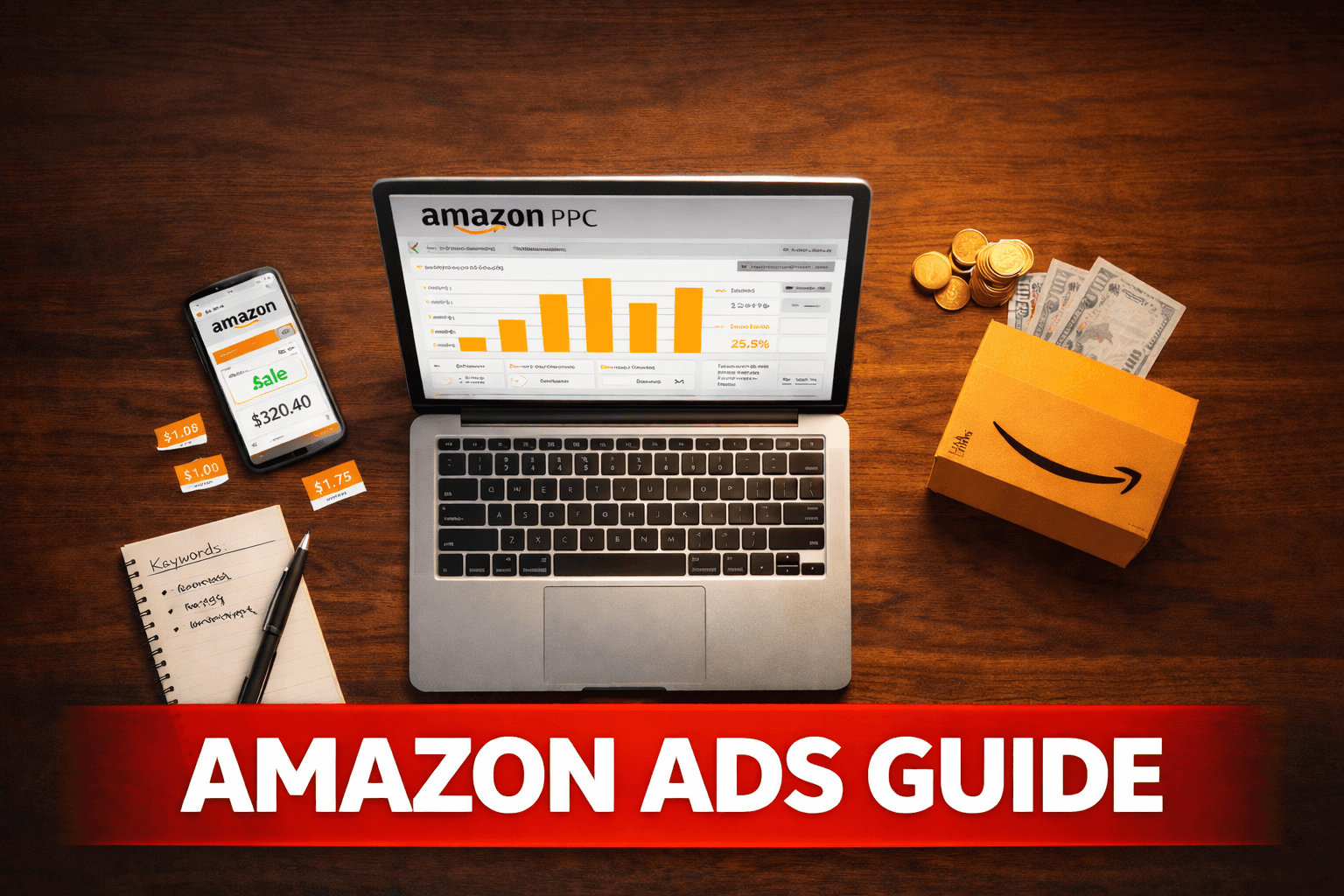
Selling on Amazon without advertising is like opening a shop and hoping people wander in. The platform has become increasingly competitive, especially in high demand categories like electronics, supplements, and beauty. For sellers launching new products with limited reviews, organic visibility alone is rarely enough to generate consistent sales.
Understanding how Amazon advertising works, and how to use it strategically, is now essential for sellers at every stage. Whether you are managing a single product or scaling a full catalogue, the right advertising approach can mean the difference between stagnation and sustainable growth.
This guide covers the core concepts behind Amazon advertising, how it works in practice, and how sellers can apply it effectively. If you are new to selling on Amazon, start with our complete guide to selling on Amazon before diving into advertising.
Why Advertising on Amazon Matters
Amazon's search results page works similarly to Google: the top positions get the most clicks and sales. But unlike Google, Amazon's algorithm heavily weights sales velocity when determining organic rankings. This creates a powerful feedback loop:
More advertising → More sales → Better organic ranking → More organic sales → More total revenue
Sellers who invest in advertising don't just get ad-driven sales. They also build the organic ranking momentum that generates free traffic over time. For private label sellers launching new products, especially in competitive categories like supplements, electronics, or beauty, skipping advertising almost guarantees poor visibility and stagnant sales.
The Advertising Options
Amazon offers several advertising formats, each with different strengths:
Sponsored Products: Your most important ad type. These promote individual product listings within search results and on product detail pages. They look like organic listings and have the highest conversion rates of any Amazon ad format.
Who should use them: Every seller, from day one.
Typical use case: Launching new products or scaling high-converting listings.
Sponsored Brands: Banner-style ads at the top of search results featuring your brand logo, a headline, and up to three products. Available only to Brand Registered sellers.
Who should use them: Established sellers who want to build brand awareness and drive traffic to their brand store or product collection.
Typical use case: Promoting a product range or driving traffic to a branded storefront.
Sponsored Display: Display ads that appear on product detail pages, customer review pages, and even off Amazon on third-party websites and apps. Target shoppers by behaviour (what they viewed, what they bought, what they're interested in).
Who should use them: Sellers who want to retarget shoppers who viewed their product but didn't purchase, or target shoppers browsing competitor products.
Typical use case: Re-engaging shoppers who visited your listing or targeting competitor product pages.
Amazon DSP (Demand Side Platform): Programmatic display and video advertising across Amazon's ecosystem and the broader web. This is Amazon's most sophisticated (and expensive) advertising tool.
Who should use them: Larger sellers and brands with significant advertising budgets looking for advanced audience targeting and cross-channel reach.
Typical use case: Running cross-platform campaigns that reach audiences both on and off Amazon.
For most sellers, Sponsored Products should account for 60 to 80% of your advertising budget. Add Sponsored Brands and Sponsored Display as you grow.
How Amazon's Ad Auction Works
Amazon advertising runs on an auction system. When a shopper searches for a keyword, Amazon runs an instant auction among all advertisers targeting that keyword. The winner's ad gets shown.
But it's not just about who bids the highest. Amazon also considers:
Relevance: How relevant your product is to the search term. A better-optimised listing improves your relevance score.
Expected click-through rate: Based on your ad's historical performance. Better images and titles lead to higher CTR.
Bid amount: How much you're willing to pay per click.
The practical implication: a well-optimised listing with strong images and relevant keywords can win impressions at a lower bid than a poorly optimised competitor, because it is more likely to convert. Advertising and listing optimisation work together.
Building Your Advertising Strategy
Once the fundamentals are clear, the next step is applying advertising in a structured way.
Phase 1: Discovery (Weeks 1 to 4)
Start with Sponsored Products automatic campaigns. Let Amazon find relevant search terms for your product. Set a moderate daily budget (AED 50 to 100) and collect data. If you are using Fulfilment by Amazon, understanding how FBA works will also help you set realistic budgets and margin expectations.
During this phase, your ACoS will likely be higher than your target. That's normal. You are investing in data that will inform your strategy going forward.
Phase 2: Refinement (Weeks 4 to 8)
Analyse your search term reports. Create manual campaigns targeting your best-performing keywords with exact and phrase match. Add negative keywords to eliminate wasteful spend.
You should start seeing your ACoS decrease as you focus spend on converting keywords.
Phase 3: Scaling (Weeks 8+)
Increase budgets on profitable campaigns. Add Sponsored Brands to capture top-of-search real estate. Test Sponsored Display for retargeting and competitor targeting.
At this stage, focus on total profitability (organic + ad-driven sales) rather than just ACoS.
Key Metrics and Benchmarks
The following ranges are general benchmarks based on typical category performance. Actual results will vary depending on your product, category, price point, and competition level. Use them as a starting point for evaluating your campaigns, not as fixed targets.
ACoS (Advertising Cost of Sale)
Launch phase: 30 to 50% (investing in visibility)
Growth phase: 20 to 35%
Mature phase: 15 to 25%
TACoS (Total Advertising Cost of Sale)
Your ad spend divided by total revenue (organic + ad-driven). This is a better measure of advertising efficiency than ACoS alone, because it captures the organic sales uplift from advertising.
Good TACoS: 8 to 15%
ROAS (Return on Ad Spend)
Launch phase: 2 to 3x
Growth phase: 3 to 5x
Mature phase: 4 to 7x
Click-Through Rate (CTR)
Typical range: around 0.3 to 0.5%+, though this varies significantly by category and ad placement.
Low CTR often indicates issues with your main image, title, or pricing.
Conversion Rate
Typical range: around 10 to 15%+, depending on category, price point, and listing quality.
Low conversion rate often indicates listing quality issues.
Additional Optimisation Tactics
Once campaigns are stable, these tactics can help improve efficiency and capture additional opportunities.
Dayparting: Adjusting your bids or budgets based on time of day. Some products convert better during evening hours when shoppers are at home browsing.
Product targeting: Showing your ads on specific competitor product pages. This works well when your product has clear advantages over the competitor, such as a higher rating, more reviews, a lower price point, or additional features that the competing listing lacks.
Brand defence: Bidding on your own brand name to prevent competitors from stealing your traffic.
Seasonal campaigns: Increasing budgets during peak shopping periods (Ramadan, White Friday, back-to-school, summer sales).
A/B testing: Testing different main images, titles, and prices to see which combination drives the best advertising performance.
Common Mistakes
Choosing not to advertise when launching a new product. Hoping for organic sales alone in a competitive marketplace rarely works, especially in categories with established sellers running active campaigns.
Relying only on automatic campaigns. They are useful for keyword discovery in the first few weeks, but without manual campaigns you lose control over which search terms your budget goes toward.
Chasing low ACoS at the expense of growth. For a product with fewer than 50 reviews in a competitive category, a higher ACoS is often worth it if it is driving sales velocity and organic ranking improvements.
Advertising a bad listing. Driving traffic to a listing with poor images, weak bullet points, and fewer than 15 reviews is like pouring water into a leaky bucket. Fix the listing first before increasing your ad spend.
Not tracking profitability at the product level. Some products are profitable to advertise; others aren't. Know which is which.
Ignoring Sponsored Brands and Display once you are past the launch phase. These formats complement Sponsored Products by capturing shoppers at different stages, from initial brand discovery to retargeting after a product page visit.
When to Outsource
Managing Amazon advertising well takes significant time and expertise. In some cases, handling it internally becomes difficult or inefficient. This is more likely when:
You're spending more than AED 5,000/month on ads
You don't have time to optimise campaigns weekly
Your ACoS is trending upward and you don't know why
You want to scale but aren't sure how to structure your campaigns
In many cases, improved campaign structure and ongoing optimisation can lead to better efficiency and more consistent performance over time. If you would prefer expert support with your Amazon advertising, our team manages campaigns for sellers across the UAE and KSA as part of our Amazon advertising agency services.
For sellers who need support beyond advertising, this often extends to broader account management, including listing optimisation, inventory planning, and operational oversight.
Final Thoughts
Amazon advertising is a skill that rewards learning and consistent effort. The fundamentals are straightforward: target relevant keywords, bid appropriately, optimise your listings, and refine based on data.
The sellers who take advertising seriously consistently outperform those who don't. It's not about having the biggest budget. It's about using your budget intelligently. The key is not just running ads, but understanding which signals Amazon’s algorithm responds to and consistently reinforcing them through both advertising and listing optimisation.
For sellers managing multiple products or scaling into competitive categories, a structured and consistently optimised advertising approach can significantly improve performance over time.
If you are just getting started, focus on one thing: launch Sponsored Products automatic campaigns, collect four weeks of data, then build manual campaigns from your best performing search terms. That single sequence accounts for the majority of early advertising success.
Frequently Asked Questions
What is a good ACoS for new Amazon sellers?
For sellers in the launch phase, an ACoS of 30 to 50% is typical and expected. The goal at this stage is building sales velocity and ranking momentum, not immediate profitability. As you refine campaigns and focus on converting keywords, aim to bring ACoS down to 15 to 25% at maturity.
How much should I spend on Amazon ads when starting out?
Start with a moderate daily budget of AED 50 to 100 per product during the discovery phase. This provides enough data to identify which keywords convert without overcommitting spend. Scale your budget once you have clear profitability data.
Can I start with just Sponsored Products?
Yes. Sponsored Products should be your primary ad format, especially at launch. They deliver the highest conversion rates and appear directly in search results. Most sellers should allocate 60 to 80% of their budget to Sponsored Products before expanding into other formats.
When should I start using Sponsored Brands?
Once your Sponsored Products campaigns are running profitably and you have Brand Registry, Sponsored Brands help capture top of search visibility. They work best for sellers with multiple products who want to drive traffic to a brand store or product collection.
How long does it take for Amazon ads to improve organic rankings?
Results vary by category and competition level, but most sellers see measurable organic ranking improvements within 4 to 8 weeks of consistent advertising. More ad driven sales signal relevance to Amazon's algorithm, which improves organic placement over time.
Should I pause ads if my product is not profitable yet?
Not necessarily. In the early stages, especially during launch, it’s normal for campaigns to run at a higher ACoS while you build data, reviews, and sales velocity. Instead of pausing ads completely, focus on optimising them—identify converting keywords, reduce wasted spend with negative keywords, and improve your listing. Turning off ads too early can stall both paid and organic growth.
Selling on Amazon without advertising is like opening a shop and hoping people wander in. The platform has become increasingly competitive, especially in high demand categories like electronics, supplements, and beauty. For sellers launching new products with limited reviews, organic visibility alone is rarely enough to generate consistent sales.
Understanding how Amazon advertising works, and how to use it strategically, is now essential for sellers at every stage. Whether you are managing a single product or scaling a full catalogue, the right advertising approach can mean the difference between stagnation and sustainable growth.
This guide covers the core concepts behind Amazon advertising, how it works in practice, and how sellers can apply it effectively. If you are new to selling on Amazon, start with our complete guide to selling on Amazon before diving into advertising.
Why Advertising on Amazon Matters
Amazon's search results page works similarly to Google: the top positions get the most clicks and sales. But unlike Google, Amazon's algorithm heavily weights sales velocity when determining organic rankings. This creates a powerful feedback loop:
More advertising → More sales → Better organic ranking → More organic sales → More total revenue
Sellers who invest in advertising don't just get ad-driven sales. They also build the organic ranking momentum that generates free traffic over time. For private label sellers launching new products, especially in competitive categories like supplements, electronics, or beauty, skipping advertising almost guarantees poor visibility and stagnant sales.
The Advertising Options
Amazon offers several advertising formats, each with different strengths:
Sponsored Products: Your most important ad type. These promote individual product listings within search results and on product detail pages. They look like organic listings and have the highest conversion rates of any Amazon ad format.
Who should use them: Every seller, from day one.
Typical use case: Launching new products or scaling high-converting listings.
Sponsored Brands: Banner-style ads at the top of search results featuring your brand logo, a headline, and up to three products. Available only to Brand Registered sellers.
Who should use them: Established sellers who want to build brand awareness and drive traffic to their brand store or product collection.
Typical use case: Promoting a product range or driving traffic to a branded storefront.
Sponsored Display: Display ads that appear on product detail pages, customer review pages, and even off Amazon on third-party websites and apps. Target shoppers by behaviour (what they viewed, what they bought, what they're interested in).
Who should use them: Sellers who want to retarget shoppers who viewed their product but didn't purchase, or target shoppers browsing competitor products.
Typical use case: Re-engaging shoppers who visited your listing or targeting competitor product pages.
Amazon DSP (Demand Side Platform): Programmatic display and video advertising across Amazon's ecosystem and the broader web. This is Amazon's most sophisticated (and expensive) advertising tool.
Who should use them: Larger sellers and brands with significant advertising budgets looking for advanced audience targeting and cross-channel reach.
Typical use case: Running cross-platform campaigns that reach audiences both on and off Amazon.
For most sellers, Sponsored Products should account for 60 to 80% of your advertising budget. Add Sponsored Brands and Sponsored Display as you grow.
How Amazon's Ad Auction Works
Amazon advertising runs on an auction system. When a shopper searches for a keyword, Amazon runs an instant auction among all advertisers targeting that keyword. The winner's ad gets shown.
But it's not just about who bids the highest. Amazon also considers:
Relevance: How relevant your product is to the search term. A better-optimised listing improves your relevance score.
Expected click-through rate: Based on your ad's historical performance. Better images and titles lead to higher CTR.
Bid amount: How much you're willing to pay per click.
The practical implication: a well-optimised listing with strong images and relevant keywords can win impressions at a lower bid than a poorly optimised competitor, because it is more likely to convert. Advertising and listing optimisation work together.
Building Your Advertising Strategy
Once the fundamentals are clear, the next step is applying advertising in a structured way.
Phase 1: Discovery (Weeks 1 to 4)
Start with Sponsored Products automatic campaigns. Let Amazon find relevant search terms for your product. Set a moderate daily budget (AED 50 to 100) and collect data. If you are using Fulfilment by Amazon, understanding how FBA works will also help you set realistic budgets and margin expectations.
During this phase, your ACoS will likely be higher than your target. That's normal. You are investing in data that will inform your strategy going forward.
Phase 2: Refinement (Weeks 4 to 8)
Analyse your search term reports. Create manual campaigns targeting your best-performing keywords with exact and phrase match. Add negative keywords to eliminate wasteful spend.
You should start seeing your ACoS decrease as you focus spend on converting keywords.
Phase 3: Scaling (Weeks 8+)
Increase budgets on profitable campaigns. Add Sponsored Brands to capture top-of-search real estate. Test Sponsored Display for retargeting and competitor targeting.
At this stage, focus on total profitability (organic + ad-driven sales) rather than just ACoS.
Key Metrics and Benchmarks
The following ranges are general benchmarks based on typical category performance. Actual results will vary depending on your product, category, price point, and competition level. Use them as a starting point for evaluating your campaigns, not as fixed targets.
ACoS (Advertising Cost of Sale)
Launch phase: 30 to 50% (investing in visibility)
Growth phase: 20 to 35%
Mature phase: 15 to 25%
TACoS (Total Advertising Cost of Sale)
Your ad spend divided by total revenue (organic + ad-driven). This is a better measure of advertising efficiency than ACoS alone, because it captures the organic sales uplift from advertising.
Good TACoS: 8 to 15%
ROAS (Return on Ad Spend)
Launch phase: 2 to 3x
Growth phase: 3 to 5x
Mature phase: 4 to 7x
Click-Through Rate (CTR)
Typical range: around 0.3 to 0.5%+, though this varies significantly by category and ad placement.
Low CTR often indicates issues with your main image, title, or pricing.
Conversion Rate
Typical range: around 10 to 15%+, depending on category, price point, and listing quality.
Low conversion rate often indicates listing quality issues.
Additional Optimisation Tactics
Once campaigns are stable, these tactics can help improve efficiency and capture additional opportunities.
Dayparting: Adjusting your bids or budgets based on time of day. Some products convert better during evening hours when shoppers are at home browsing.
Product targeting: Showing your ads on specific competitor product pages. This works well when your product has clear advantages over the competitor, such as a higher rating, more reviews, a lower price point, or additional features that the competing listing lacks.
Brand defence: Bidding on your own brand name to prevent competitors from stealing your traffic.
Seasonal campaigns: Increasing budgets during peak shopping periods (Ramadan, White Friday, back-to-school, summer sales).
A/B testing: Testing different main images, titles, and prices to see which combination drives the best advertising performance.
Common Mistakes
Choosing not to advertise when launching a new product. Hoping for organic sales alone in a competitive marketplace rarely works, especially in categories with established sellers running active campaigns.
Relying only on automatic campaigns. They are useful for keyword discovery in the first few weeks, but without manual campaigns you lose control over which search terms your budget goes toward.
Chasing low ACoS at the expense of growth. For a product with fewer than 50 reviews in a competitive category, a higher ACoS is often worth it if it is driving sales velocity and organic ranking improvements.
Advertising a bad listing. Driving traffic to a listing with poor images, weak bullet points, and fewer than 15 reviews is like pouring water into a leaky bucket. Fix the listing first before increasing your ad spend.
Not tracking profitability at the product level. Some products are profitable to advertise; others aren't. Know which is which.
Ignoring Sponsored Brands and Display once you are past the launch phase. These formats complement Sponsored Products by capturing shoppers at different stages, from initial brand discovery to retargeting after a product page visit.
When to Outsource
Managing Amazon advertising well takes significant time and expertise. In some cases, handling it internally becomes difficult or inefficient. This is more likely when:
You're spending more than AED 5,000/month on ads
You don't have time to optimise campaigns weekly
Your ACoS is trending upward and you don't know why
You want to scale but aren't sure how to structure your campaigns
In many cases, improved campaign structure and ongoing optimisation can lead to better efficiency and more consistent performance over time. If you would prefer expert support with your Amazon advertising, our team manages campaigns for sellers across the UAE and KSA as part of our Amazon advertising agency services.
For sellers who need support beyond advertising, this often extends to broader account management, including listing optimisation, inventory planning, and operational oversight.
Final Thoughts
Amazon advertising is a skill that rewards learning and consistent effort. The fundamentals are straightforward: target relevant keywords, bid appropriately, optimise your listings, and refine based on data.
The sellers who take advertising seriously consistently outperform those who don't. It's not about having the biggest budget. It's about using your budget intelligently. The key is not just running ads, but understanding which signals Amazon’s algorithm responds to and consistently reinforcing them through both advertising and listing optimisation.
For sellers managing multiple products or scaling into competitive categories, a structured and consistently optimised advertising approach can significantly improve performance over time.
If you are just getting started, focus on one thing: launch Sponsored Products automatic campaigns, collect four weeks of data, then build manual campaigns from your best performing search terms. That single sequence accounts for the majority of early advertising success.
Frequently Asked Questions
What is a good ACoS for new Amazon sellers?
For sellers in the launch phase, an ACoS of 30 to 50% is typical and expected. The goal at this stage is building sales velocity and ranking momentum, not immediate profitability. As you refine campaigns and focus on converting keywords, aim to bring ACoS down to 15 to 25% at maturity.
How much should I spend on Amazon ads when starting out?
Start with a moderate daily budget of AED 50 to 100 per product during the discovery phase. This provides enough data to identify which keywords convert without overcommitting spend. Scale your budget once you have clear profitability data.
Can I start with just Sponsored Products?
Yes. Sponsored Products should be your primary ad format, especially at launch. They deliver the highest conversion rates and appear directly in search results. Most sellers should allocate 60 to 80% of their budget to Sponsored Products before expanding into other formats.
When should I start using Sponsored Brands?
Once your Sponsored Products campaigns are running profitably and you have Brand Registry, Sponsored Brands help capture top of search visibility. They work best for sellers with multiple products who want to drive traffic to a brand store or product collection.
How long does it take for Amazon ads to improve organic rankings?
Results vary by category and competition level, but most sellers see measurable organic ranking improvements within 4 to 8 weeks of consistent advertising. More ad driven sales signal relevance to Amazon's algorithm, which improves organic placement over time.
Should I pause ads if my product is not profitable yet?
Not necessarily. In the early stages, especially during launch, it’s normal for campaigns to run at a higher ACoS while you build data, reviews, and sales velocity. Instead of pausing ads completely, focus on optimising them—identify converting keywords, reduce wasted spend with negative keywords, and improve your listing. Turning off ads too early can stall both paid and organic growth.
Ready to grow your Amazon business with Expert Guidance?
Join 1000+ growing network of Amazon entrepreneurs building real, profitable brands.
THINK
BIG!
SELL
BIGGER!!



sellerssociety©️2026
All Rights Reserved
Ready to grow your Amazon business with Expert Guidance?
Join 1000+ growing network of Amazon entrepreneurs building real, profitable brands.
THINK
BIG!
SELL
BIGGER!!
sellerssociety©️2026
All Rights Reserved
Ready to grow your Amazon business with Expert Guidance?
Join 1000+ growing network of Amazon entrepreneurs building real, profitable brands.
THINK
BIG!
SELL
BIGGER!!
sellerssociety©️2026
All Rights Reserved